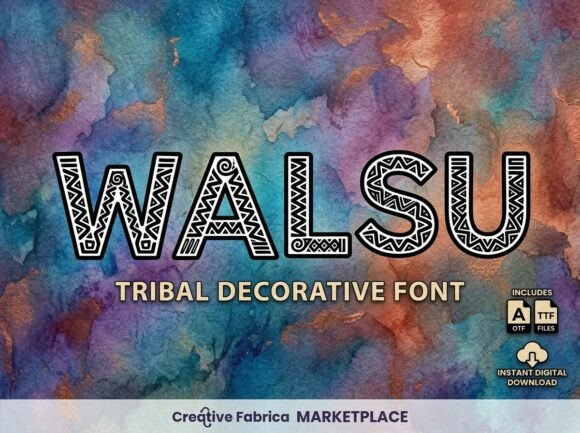
Walsu: Elevating Heritage Branding with Ancient Rhythms
In the saturated landscape of modern digital design, creating a visual identity that feels both authentically ancient and professionally polished is a significant challenge. Designers and brand strategists often struggle to find typography that communicates deep cultural roots without resorting to clichés or illegible novelty fonts. This is where Walsu emerges as a vital solution. Walsu is not merely a display typeface; it is a breathtaking visual instrument that captures a traditional-and-textured soul, specifically engineered for projects requiring historical weight and artisanal authenticity.
Walsu distinguishes itself through bold, hollow letterforms masterfully filled with a dense tapestry of rhythmic, hand-drawn tribal patterns. Inspired by neolithic art, these zigzags and spiral glyphs transform standard text into an illustrative experience. For creative professionals seeking to bridge the gap between primitive aesthetics and contemporary layout requirements, understanding how to implement Walsu effectively is key to unlocking high-impact visual storytelling.
Solving the Authenticity Gap in Cultural Design
The primary challenge for independent global heritage brands and archaeological publications is maintaining respect for tradition while ensuring modern readability. Standard serif or sans-serif fonts often feel too sterile for organic products, while many "tribal" style fonts lack the refinement necessary for professional packaging or editorial use. They may look decorative but fail to function as cohesive typographic systems.
Walsu addresses this friction point by balancing heavy illustrative weight with structured legibility. The font’s personality is undeniably primitive, yet its construction adheres to typographic standards that allow it to anchor a design rather than overwhelm it. When your goal is to evoke the tactile sensation of carved stone, woven textiles, or ancient pottery, Walsu provides a texture that raster images or standard vector shapes cannot replicate. It solves the problem of "flat" design in heritage sectors by embedding the texture directly into the communication layer.
Strategic Applications for Artisanal and Heritage Brands
To maximize the effectiveness of Walsu, it is essential to apply it in contexts where its intricate details can be appreciated. Because the letterforms contain dense internal patterns, this typeface performs best at large sizes. It is a premier choice for specific high-value touchpoints rather than body copy.
Artisanal Jewelry and Craft Labels
For makers of handmade jewelry, ceramics, or textiles, the packaging is an extension of the product's value. Using Walsu on hang tags, box lids, or certificate of authenticity cards immediately signals that the item within is crafted with intention. The spiral glyphs and zigzag patterns mirror the repetitive motions of handcrafting, creating a subconscious link between the typography and the artisan’s labor. In this context, Walsu acts as a seal of quality, distinguishing genuine handmade goods from mass-produced imitations.
Archaeological and Museum Editorial Layouts
Curators and editorial designers face the unique task of making historical content engaging for modern audiences. Walsu serves as an excellent tool for chapter titles, exhibition signage, and pull quotes in archaeological publications. Its neolithic inspiration aligns perfectly with subject matter regarding early human history, indigenous cultures, or anthropological studies. By using a typeface that visually references the era being discussed, designers create an immersive reading experience that reinforces the narrative before the viewer even reads the content.
Mystical and Macramé Social Media Headers
Social media platforms demand instant visual recognition. For niches centered around spirituality, bohemian aesthetics, or fiber arts like macramé, Walsu offers a distinct advantage in feed scrolling. Its heavy weight ensures readability even when scaled down for mobile screens, while the internal textures remain visible enough to add character. Using Walsu for Instagram highlights, YouTube thumbnails, or Pinterest headers creates a consistent brand atmosphere that feels mystical yet grounded. It moves beyond generic "boho" fonts by offering a more structured, historically informed aesthetic.
Practical Implementation Guidelines
While Walsu is versatile within its niche, successful implementation requires adherence to specific design principles. Treating this display font with the same rules as standard text will lead to poor outcomes. Consider the following practical recommendations to ensure your project succeeds.
- Prioritize Negative Space: Because Walsu features dense internal patterning, it requires generous breathing room. Crowding the letters against other graphical elements or margins will cause visual vibration and reduce legibility. Let the typeface stand alone as a graphic element.
- Pair with Minimalist Supporting Type: To prevent the design from becoming chaotic, pair Walsu with clean, neutral sans-serifs or simple geometric serifs. The contrast between the ornate, rhythmic nature of Walsu and a quiet supporting font creates a professional hierarchy that guides the eye effectively.
- Limit Character Count: Walsu is most effective in short bursts. Use it for headlines, logos, or single-word emphasis. Long sentences rendered in this style become difficult to parse quickly. Reserve the font for moments where you want the viewer to pause and appreciate the form.
- Test Across Backgrounds: The hollow nature of the letterforms means background color plays a massive role in perception. High contrast is non-negotiable. Test your designs on both light and dark backgrounds to ensure the internal zigzags and spirals do not get lost or create moiré effects in print production.
Tailoring the Approach for Different User Needs
Different stakeholders will leverage Walsu to achieve varying outcomes. Understanding these distinctions helps in selecting the right application strategy.
Brand Strategists should view Walsu as a differentiator in a crowded market. If competitors are using clean, modern minimalism, introducing Walsu signals a pivot toward heritage and depth. It is a strategic asset for rebranding efforts aimed at older demographics or luxury artisan markets.
Graphic Designers should treat Walsu as an illustration tool. Rather than searching for stock vectors of tribal patterns to overlay on text, the font integrates these elements natively. This streamlines workflow and ensures that the decorative elements align perfectly with the typographic grid, resulting in cleaner files and more cohesive compositions.
Content Creators and Influencers in the wellness or history spaces should use Walsu to establish immediate topical authority. The font acts as a visual shorthand for "ancient wisdom" or "traditional craft," helping to attract an audience interested in those specific themes before they engage with the caption or video content.
Embracing the Textured Soul of Typography
Ultimately, choosing Walsu is a decision to prioritize emotion and texture over neutrality. It is a typeface for those who understand that typography is not just about conveying information, but about evoking a feeling. Whether you are designing a label for a small-batch ceramic studio, laying out a museum catalog, or crafting a social media identity for a spiritual practice, Walsu provides the rhythmic foundation necessary to ground your work in something timeless.
By respecting the font’s illustrative weight and applying it with strategic restraint, you unearth ancient rhythms that resonate with modern audiences. Walsu transforms text from a mere vessel of language into a tangible artifact of design, ensuring your message carries the profound, textured soul of the traditions it seeks to honor.