Deity: Elevating Space Branding with Galactic Typography
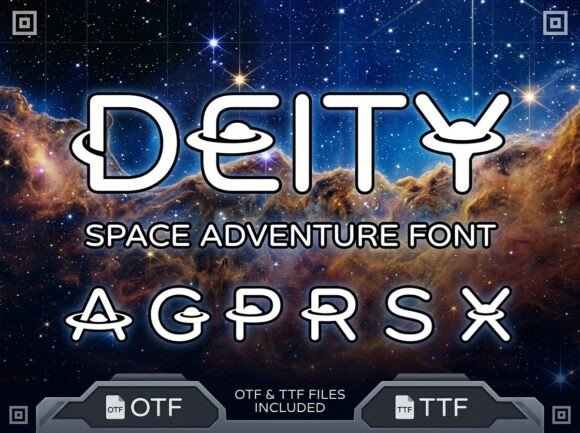
In the competitive landscape of science fiction gaming, astronomical education, and futuristic technology branding, standard typography often fails to capture the true essence of the cosmos. Designers and brand managers frequently encounter a specific creative hurdle: finding a typeface that communicates advanced technology and celestial wonder without resorting to clichéd, jagged alien scripts or illegible grunge textures. This is where Deity enters the design ecosystem. Deity is not merely a decorative font; it is a specialized typographic tool designed to bridge the gap between clean modernist legibility and high-concept space aesthetics. By integrating stylized Saturn-like rings and planetary icons directly into the letterforms, Deity offers a practical solution for projects requiring immediate visual context and galactic impact.
Solving the Sci-Fi Legibility Paradox
The primary challenge in space-themed design is balancing atmosphere with function. Many display fonts in this genre sacrifice readability for style, resulting in headers that look exciting but cannot be parsed quickly by an audience. For user interfaces in video games, app icons for astronomy tools, or merchandise for tech startups, clarity is non-negotiable. Deity addresses this friction point through its rounded monoline construction. Unlike distressed or overly complex sci-fi fonts, Deity maintains a consistent stroke width and geometric foundation. This ensures that even when the horizontal crossbars are replaced by orbital rings, the underlying character structure remains familiar to the human eye.
This techno-optimist aesthetic serves a distinct psychological purpose. It suggests a future that is organized, safe, and wondrous rather than dystopian or chaotic. For brands aiming to inspire confidence alongside curiosity—such as educational planetariums, sustainable aerospace companies, or positive-future gaming narratives—this specific tonal balance is essential. Deity provides the "wow factor" of outer space while retaining the professional polish required for commercial applications.
Practical Applications Across Industries
Understanding how to implement Deity effectively requires looking at specific use cases where its unique features solve real-world communication problems. The font’s integration of negative space and planetary imagery makes it versatile across several key sectors:
- Sci-Fi Gaming Titles and UI: In gaming, the title screen sets the expectation for the entire experience. Deity works exceptionally well for main menus and chapter headers because the planetary icons act as built-in graphical elements, reducing the need for separate icon assets. For in-game HUDs (Heads-Up Displays), the monoline weight ensures text remains crisp against complex, starry backgrounds or neon interfaces.
- Astronomical and Educational Branding: Museums, observatories, and space camps need to appeal to both serious enthusiasts and younger audiences. Deity’s rounded forms feel approachable and friendly, avoiding the sterile coldness of technical manuals while maintaining scientific credibility. It is ideal for exhibit signage, workshop flyers, and educational app interfaces where engagement is the primary metric of success.
- Tech Startup Identity: New ventures in satellite communications, orbital logistics, or VR exploration often struggle to differentiate themselves visually. Using Deity in a logotype instantly signals industry relevance. Because the font replaces crossbars with rings, it can turn a simple wordmark into a composite logo-symbol hybrid, saving smaller startups significant budget on custom illustration work.
- Cosmic Social Media Graphics: On platforms like Instagram and TikTok, thumbnails must communicate content instantly. Deity’s high contrast and distinctive silhouettes perform well at small sizes, making it perfect for quote cards, event announcements, and short-form video overlays related to space culture.
Implementation Strategies for Maximum Impact
To get the most out of Deity, designers should approach it as a headline-first solution. While the monoline structure supports shorter subheads, the font shines brightest in large-format display settings where the planetary details are visible. When setting text in Deity, pay close attention to tracking (letter spacing). Because the characters contain internal graphic elements like rings, tightening the tracking too much can cause visual clutter where the orbits intersect with adjacent letters. A slightly more open tracking setting often enhances the "floating in zero gravity" sensation that defines the typeface's charm.
Color selection also plays a pivotal role in leveraging Deity’s strengths. While white-on-black is the classic space trope, exploring gradient fills can activate the ring elements within the letters. Applying a subtle metallic sheen or a nebula-inspired gradient specifically to the horizontal strokes can make the planetary icons appear three-dimensional. Conversely, using a flat, vibrant color palette can push the aesthetic toward retro-futurism or synthwave, demonstrating the font's adaptability beyond pure realism.
Tailoring Deity to Different User Needs
Different stakeholders will utilize Deity to achieve varying outcomes, and recognizing these distinctions is key to successful deployment. Game developers might prioritize the font’s ability to convey lore and immersion, using it to distinguish ancient alien civilizations from human factions based solely on typographic tone. In this context, Deity represents a unified, advanced civilization aesthetic.
Marketing teams, however, may focus on conversion and brand recall. For them, Deity is a pattern-interrupt tool. In a feed dominated by standard sans-serifs, a header set in Deity stops the scroll. These users should test the font extensively in thumbnail sizes to ensure the planetary details do not become muddy artifacts on mobile screens. If legibility at small sizes becomes an issue, pairing Deity with a clean, neutral sans-serif for body copy creates a hierarchy that guides the viewer from the cosmic hook to the actionable information.
Educators and content creators often need flexibility. They may find that using Deity for every single word in a sentence dilutes its power. Instead, utilizing the font only for keywords, drop caps, or pull quotes allows the celestial theme to permeate the design without overwhelming the reader. This selective application respects the audience's cognitive load while still delivering the promised sense of wonder.
Moving Beyond Decoration to Communication
Ultimately, the value of Deity lies in its ability to function as more than just decoration. It is a semantic shorthand for innovation, exploration, and optimism. When you choose this typeface, you are not just selecting a shape for your letters; you are adopting a visual language that speaks directly to the human fascination with the unknown. Whether you are building the next great space sim, launching an app to track meteor showers, or rebranding a science center, Deity provides the typographic infrastructure necessary to make your vision feel tangible.
By focusing on clean geometry and meaningful symbolism, Deity empowers creators to explore the outer reaches of their imagination without losing sight of practical design principles. It transforms ordinary text into a window to the stars, ensuring that your message resonates with the same magnitude as the universe it seeks to represent. For those ready to elevate their cosmic projects, Deity stands as a testament to the idea that typography itself can be a vessel for discovery.