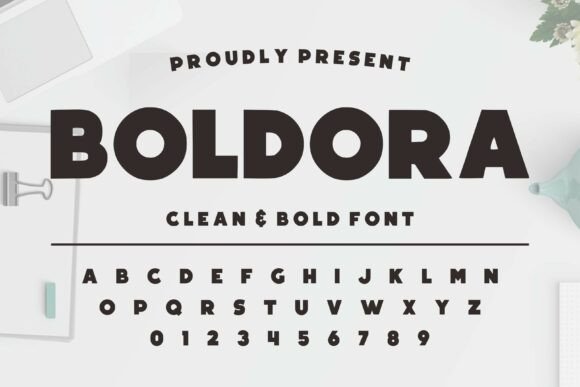
Boldora: Why Modern Design Demands Unapologetic Typography
In an era defined by infinite scrolling and fleeting attention spans, the visual hierarchy of digital and print media has undergone a radical transformation. We are no longer designing for passive reading; we are designing for immediate recognition. Within this high-stakes environment, typography has shifted from a subtle backdrop to a primary vehicle for communication. Enter Boldora, a clean and bold display font that has emerged as a definitive answer to the contemporary need for visual authority. Designed to make a strong visual impact, Boldora represents more than just a stylistic choice; it is a strategic tool for professionals, marketers, and creators navigating a saturated visual landscape.
The rise of typefaces like Boldora is not an isolated trend but a direct response to changing consumer behaviors and technological constraints. As screens become denser and content volumes increase, the margin for error in headline design shrinks. This typeface, with its thick strokes and modern structure, addresses the fundamental challenge of modern branding: how to be seen, understood, and remembered in a fraction of a second. Its minimalist yet powerful style offers a professional and contemporary feel that transcends temporary fads, making it versatile for both creative expression and commercial necessity.
The Shift Toward Assertive Visual Communication
To understand why Boldora is gaining traction among entrepreneurs and designers, one must first understand the current state of visual culture. For years, the design industry leaned heavily into ultra-thin weights and delicate serifs, prioritizing elegance over legibility. However, the pendulum has swung back toward robustness. This shift is driven by the realities of mobile-first consumption and accessibility standards. Thin fonts often struggle on low-resolution screens or against complex photographic backgrounds, whereas bold display fonts maintain their integrity across all mediums.
Boldora fits squarely into this movement toward assertive communication. It rejects the notion that professionalism requires quietness. Instead, it leverages weight as a signifier of confidence. In marketing and advertising, this translates to higher engagement rates. When a user encounters a headline set in Boldora, the cognitive load required to process the message is reduced. The form itself communicates urgency and importance before the semantic meaning of the words is even parsed. This alignment between form and function is what makes the typeface particularly relevant for today’s fast-paced digital ecosystems.
Adapting to Multi-Platform Workflows
Modern designers rarely create for a single output. A brand identity must work simultaneously on a billboard, a business card, an Instagram story, and a favicon. This demand for extreme versatility places immense pressure on type selection. A font that looks stunning at 72 points may disintegrate at 14 points, or conversely, appear clumsy when scaled up for environmental graphics.
Boldora was engineered with this multi-platform reality in mind. While it excels as a display face for eye-catching headlines and posters, its underlying geometric structure ensures consistency across varying scales. For freelancers and agencies managing comprehensive brand systems, this reliability reduces friction in the workflow. There is less time spent tweaking kerning or searching for alternative weights to fill gaps in the design system. The typeface provides a stable anchor, allowing creatives to focus on layout and messaging rather than typographic troubleshooting.
Strategic Applications in Branding and Commerce
The commercial viability of a typeface is measured by its ability to convert aesthetic appeal into business results. Boldora’s thick strokes and modern structure are not merely decorative; they serve specific psychological functions in consumer markets. In packaging design, for instance, shelf presence is paramount. Products utilizing this typeface benefit from enhanced contrast against competitors, signaling quality and modernity to shoppers making split-second decisions.
Similarly, in the realm of social media design, where algorithms favor high-contrast, text-overlay imagery, Boldora performs exceptionally well. Its clean lines remain legible even when compressed by platform algorithms or viewed on small devices. For content creators and social media managers, this means fewer rejected assets and more consistent brand recognition. The font acts as a visual shorthand, establishing a cohesive identity that followers can instantly associate with the brand, regardless of the specific content being posted.
- Logo Design: The geometric stability of Boldora allows for custom modifications and ligatures without losing structural integrity, making it ideal for wordmarks that need to stand alone.
- Editorial Layouts: In digital publishing, using this typeface for pull quotes and section headers breaks up dense text, improving readability and dwell time.
- Environmental Graphics: Wayfinding and signage require instant legibility from a distance; the heavy weight of Boldora ensures clarity in physical spaces.
- Digital Advertising: High click-through rates often correlate with clear, bold value propositions; this font maximizes the impact of limited character counts.
The Art of Contrast: Pairing and Hierarchy
While Boldora is undeniably powerful on its own, its true potential is unlocked through thoughtful pairing. A common mistake in amateur design is competing boldness—using multiple heavy fonts that fight for attention. Professional typographers understand that strength requires counterbalance. Boldora works beautifully in large sizes specifically because it pairs well with lighter fonts for contrast.
This interplay creates a dynamic visual rhythm that guides the viewer’s eye through the composition. When combined with a neutral sans-serif or a refined serif for body copy, Boldora establishes a clear hierarchy. It tells the viewer where to look first, second, and third. This is crucial in information-heavy environments like annual reports, tech dashboards, or educational materials. By anchoring the design with Boldora, creators can use whitespace more effectively, resulting in layouts that feel open and organized despite the heaviness of the display type.
Furthermore, this pairing strategy aligns with current web performance trends. Using a variable font ecosystem where Boldora handles the heavy lifting for headers while a lightweight system font handles body text can improve load times without sacrificing aesthetics. This technical consideration is increasingly important for SEO and user experience, bridging the gap between artistic vision and development constraints.
Meeting the Expectations of the Modern Consumer
Today’s consumers are sophisticated visual literates. They have been trained by years of polished UI design and curated social feeds to equate design quality with product quality. Outdated or poorly chosen typography signals neglect, while intentional, contemporary typography signals competence. Boldora satisfies this expectation of polish. Its minimalist construction avoids the baggage of historical associations, placing brands firmly in the present moment.
This forward-looking aesthetic is particularly valuable for startups and tech companies seeking to establish credibility without decades of legacy. It communicates innovation through form. However, it also serves heritage brands looking to refresh their image without alienating their core audience. Because Boldora is rooted in classic geometric principles, it feels familiar enough to be trusted but distinct enough to be noticed. This duality is rare in display fonts and explains its growing adoption across diverse industries.
Future-Proofing Your Visual Identity
Trends in typography are cyclical, but the need for clarity is permanent. Investing in a typeface like Boldora is an investment in longevity. Unlike novelty fonts that define a specific year or season, its clean structure allows it to adapt to future design movements. Whether the next wave favors brutalism, neo-grotesque, or organic softness, Boldora’s neutrality allows it to coexist and complement evolving styles.
For professionals and enthusiasts alike, mastering the use of such a versatile tool is essential. It encourages a discipline of restraint; because the font is so loud, the surrounding elements must be deliberate. It forces designers to think critically about negative space, color theory, and message prioritization. In this way, Boldora is not just a product to be consumed but a catalyst for better design thinking.
Ultimately, the relevance of Boldora lies in its ability to solve real-world communication problems. It bridges the divide between artistic expression and commercial efficacy. In a marketplace that rewards those who can speak clearly and confidently, having the right typographic voice is a competitive advantage. As we move further into an attention-scarce economy, tools that offer both beauty and utility will continue to dominate. Boldora stands as a testament to the enduring power of bold, clean design, proving that sometimes, the most effective way to communicate is simply to speak up.