ABCD Display: A Practical Guide to Using Bold, Cheerful Typography in Education
Typography is often treated as a subtle background element in design, but when communicating with children, type needs to step into the spotlight. ABCD Display represents a specific category of typography designed not just for legibility, but for emotional engagement. As a playful, bold, and cheerful kids' education font, it serves a functional purpose beyond aesthetics. For educators, parents, and content creators, understanding how to leverage this typeface can significantly impact how young audiences receive and interact with learning materials.
The primary value of ABCD Display lies in its ability to bridge the gap between visual fun and educational clarity. Unlike standard serif or sans-serif fonts that prioritize neutrality, this typeface is engineered to capture the joyful, curious spirit of childhood. However, successful implementation requires more than simply selecting it from a dropdown menu. It demands an understanding of hierarchy, spacing, and the cognitive load of early readers. This guide explores the practical applications, strengths, and necessary considerations for integrating ABCD Display into your next project.
Defining the Visual Characteristics of Kids’ Fonts
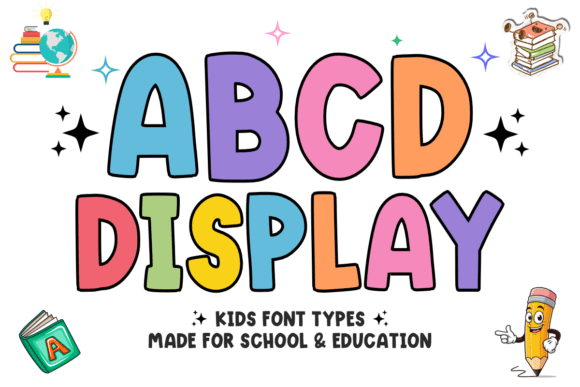
To use ABCD Display effectively, one must first understand why it looks the way it does. The font features clean outlines and chunky, friendly shapes. These are not arbitrary stylistic choices; they are rooted in the psychology of early childhood literacy. Young readers are still developing their shape recognition skills. Complex serifs, thin strokes, or irregular baselines can create visual noise that hinders comprehension.
The "bouncy" nature of ABCD Display introduces a rhythmic quality to text. While traditional typography strives for a perfectly even baseline to maintain professional formality, kids' fonts often utilize slight vertical variations to mimic handwriting or organic movement. This makes the text feel approachable rather than institutional. When evaluating this font for your work, look for these specific traits:
- High X-Height: The lowercase letters are tall relative to the capital letters, which improves readability at smaller sizes and helps distinguish similar letterforms.
- Open Counters: The enclosed spaces within letters like 'a', 'e', and 'o' are wide and open, preventing ink bleed in print and maintaining clarity on low-resolution screens.
- Rounded Terminals: Soft edges reduce visual aggression, making instructions and titles feel welcoming and safe.
- Consistent Stroke Weight: Uniform thickness ensures that no part of the letter disappears against busy backgrounds common in classroom decor.
Ideal Applications in Educational Environments
ABCD Display is categorized specifically as a display font, meaning it is optimized for headlines, signage, and short bursts of text rather than long-form reading. Recognizing this distinction is crucial for maintaining professionalism and usability. Here are the most effective scenarios for deploying this typeface:
Classroom Signage and Wayfinding
In a school setting, navigation and organization are key to student independence. ABCD Display excels in labeling cubbies, reading corners, and supply stations. Its bold weight allows it to remain legible from a distance, while its cheerful tone reinforces a positive classroom culture. Teachers often find that using a consistent, friendly font for labels helps non-readers associate specific shapes with specific locations or items, aiding in environmental print recognition.
Worksheet Headers and Activity Instructions
While body text should remain in a highly readable sans-serif like Arial or Comic Neue, worksheet titles benefit immensely from the personality of ABCD Display. A boring header can make a math drill feel tedious before the student even begins. By using this font for the title, you signal that the activity is engaging. Furthermore, the distinct letterforms help differentiate the instruction phase from the execution phase, providing clear visual cues for task transitions.
Digital Learning Assets and Social Media
For creators selling educational resources online or sharing parenting tips, thumbnail visibility is paramount. ABCD Display was crafted to be incredibly eye-catching. On platforms where users scroll quickly, the chunky shapes stand out against pastel or bright backgrounds without becoming pixelated. It conveys the "kids education" niche instantly, helping the right audience identify relevant content immediately.
Balancing Fun with Functional Legibility
A common pitfall when working with novelty or display fonts is sacrificing readability for style. While ABCD Display is designed to be highly legible, it is not immune to misuse. To ensure your designs remain accessible and useful, adhere to the following best practices.
Avoid All-Caps Settings for Long Phrases. Although capital letters might seem easier for beginners, all-caps text creates a rectangular block that removes the unique word shape cues early readers rely on. Use Title Case or Sentence Case to preserve the bouncy rhythm and distinctive silhouette of words. Reserve all-caps only for single-word emphasis like "STOP," "READ," or "MATH."
Mind Your Tracking and Leading. Chunky fonts naturally occupy more horizontal space. Tight tracking (letter-spacing) can cause the bold shapes to merge, creating muddy blobs that confuse young eyes. Increase tracking slightly to let each character breathe. Similarly, increase line height (leading) to prevent ascenders and descenders from tangling, especially given the playful vertical variance of the glyphs.
Pairing with Neutral Typefaces. ABCD Display has a strong personality. Pairing it with another decorative font will result in visual chaos. Instead, anchor it with a simple, geometric sans-serif for body copy. This contrast establishes a clear information hierarchy: the display font grabs attention and sets the mood, while the neutral font delivers the detailed content efficiently.
Evaluating Suitability for Your Specific Needs
Not every project requires a cheerful aesthetic, and ABCD Display is not a universal solution. Before downloading or purchasing, conduct a brief suitability audit based on your target demographic and medium.
- Age Appropriateness: This font is ideal for Pre-K through 3rd grade. For upper elementary or middle school students, the playfulness may be perceived as babyish. Evaluate whether the tone matches the maturity level of your audience.
- Contextual Tone: Is the material celebratory, instructional, or corrective? ABCD Display works beautifully for certificates, welcome signs, and creative prompts. It may be less appropriate for serious behavioral notices or standardized testing materials where neutrality is required.
- Technical Constraints: Consider where the final output will live. If you are designing for a platform that does not support custom web fonts, ABCD Display may not render correctly for all users. Always have a web-safe fallback strategy if using it in digital interfaces.
- Licensing Requirements: As with any specialized typeface, verify the license terms. Personal use for home schooling differs from commercial use for selling worksheets on marketplaces. Ensuring compliance protects your business and respects the creator’s work.
The Impact of Typography on Learning Mindsets
Ultimately, the choice to use ABCD Display is about more than decoration; it is about setting a psychological stage for learning. Research in educational design suggests that environment plays a significant role in student motivation. When text feels aggressive or overly sterile, it can induce anxiety or boredom. Conversely, typography that mirrors the warmth and encouragement of a good teacher helps lower the affective filter, making students more receptive to new information.
By choosing a typeface that is bold yet soft, structured yet bouncy, designers and educators communicate respect for the child's experience. It acknowledges that learning is a human endeavor filled with joy and curiosity. Whether you are a teacher decorating a bulletin board, a parent creating flashcards, or a designer building an ed-tech app, ABCD Display offers a reliable tool for making text accessible and inviting.
Incorporating this font into your toolkit is a strategic decision to prioritize user experience for the youngest among us. When used with intention and restraint, it transforms static text into an active participant in the educational journey. Remember that the goal is always clarity first, personality second. When those two elements align, ABCD Display becomes more than just a collection of vectors; it becomes a voice that says, "Learning is fun, and you belong here."