Silas: Integrating High-Impact Barbwire Tribal Typography into Visual Design
The Anatomy of Industrial-Renegade Letterforms
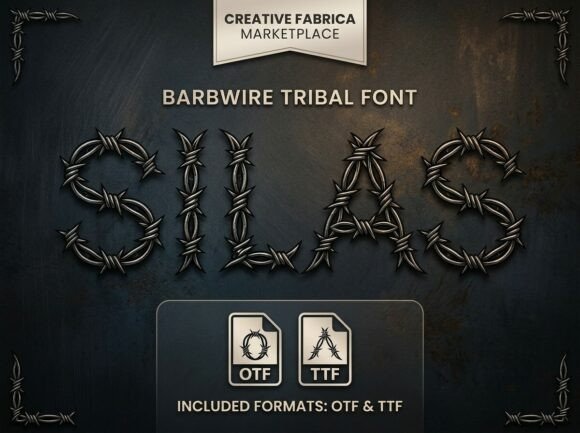
Typography serves as the visual voice of any design project, but few typefaces communicate visceral intensity as effectively as Silas. This display font diverges sharply from traditional geometric or humanist classifications by adopting a sharp-edged aesthetic rooted in industrial rebellion. Rather than relying on standard vector strokes, Silas is constructed from meticulously rendered twisted metal wire and lethal-looking thorns. This structural choice transforms each glyph into a tactile object, bridging the gap between digital typography and physical texture.
For designers and brand strategists, understanding the anatomy of Silas is crucial for effective implementation. The letterforms are not merely decorated with barbed wire; they are formed by it. The negative space within the counters is often irregular, mimicking the chaotic gaps found in actual fencing or scrap metal. This creates a high-contrast silhouette that remains legible at large sizes while conveying an aggressive texture. The "industrial-renegade soul" of the typeface is achieved through this commitment to material realism, making it distinct from cleaner, more stylized grunge fonts that simply overlay noise textures on top of standard shapes.
Material Realism vs. Stylized Grunge
A common pitfall in edgy typography is the reliance on post-processing effects to create grit. Silas avoids this by baking the texture directly into the font file. When scaling the type for different media, the integrity of the twisted wire remains intact. This distinction matters significantly for professional output:
- Vector Integrity: Because the barbs and twists are part of the glyph outline, Silas scales infinitely without losing the definition of the metal strands, unlike raster-based grunge overlays.
- Light Interaction: The three-dimensional suggestion of the wire allows for realistic lighting effects when paired with bevel, emboss, or shadow layer styles in software like Photoshop or Illustrator.
- Tactile Perception: Viewers subconsciously recognize the weight and danger associated with barbwire, triggering an immediate emotional response that smooth sans-serifs cannot replicate.
Strategic Applications Across Subcultures and Industries
The aggressive nature of Silas dictates its utility. It is not a versatile workhorse for body copy or corporate annual reports; rather, it is a specialized tool for high-impact environments where attention must be seized instantly. Its primary ecosystem exists within subcultures and industries that value raw authenticity over polished perfection.
Underground Music Festival Promotion
In the realm of live music, particularly genres like metal, hardcore, industrial, and punk, visual identity must match sonic intensity. Silas functions as an anchor for festival posters and lineup announcements. The font’s chaotic energy mirrors the mosh pit and the distorted audio landscape. When designing for these events, Silas works best as the dominant headline element. Pairing it with stark, high-contrast photography or abstract noise art reinforces the underground ethos. Crucially, because the font carries so much visual weight, supporting typography should be minimal and utilitarian—think monospaced data fonts or clean grotesques—to ensure logistical information remains readable against the ornate aggression of the title.
Independent Streetwear Branding
Streetwear relies heavily on semiotics and subcultural signaling. Brands operating in the DIY, skate, or alternative fashion spaces often seek typography that feels unauthorized or reclaimed. Silas offers a premium interpretation of this aesthetic. Unlike generic distressed fonts, the intricate wire construction suggests craftsmanship and deliberate design intent. This elevates the perceived value of merchandise. On t-shirts, hoodies, and caps, Silas reads as a graphic element rather than mere text. Designers utilizing this typeface for apparel should consider placement carefully; the sharp edges of the letters can interact dynamically with garment seams, pockets, and fabric textures, creating a cohesive physical product experience.
Automotive Decals and Motorsport Livery
High-octane automotive culture embraces danger, speed, and mechanical complexity. Silas aligns naturally with this visual language. The twisted metal aesthetic complements carbon fiber wraps, matte black paint jobs, and exposed engine components. For vehicle decals, the font’s inherent texture reduces the appearance of flatness often associated with vinyl lettering. In motorsport livery, Silas can be used for team names or sponsor callouts that require an intimidating presence. However, legibility at speed is paramount. Designers must test the font at various distances and angles to ensure the intricate thorns do not blur into illegibility when the vehicle is in motion. Often, increasing tracking (letter-spacing) helps maintain clarity in these high-speed applications.
Cinematic Grunge-Survival Social Media Headers
Digital content creators focusing on survivalism, tactical gear reviews, horror gaming, or dystopian fiction require visuals that establish atmosphere instantly. Social media headers and thumbnails have limited real estate to convey genre. Silas acts as a semantic shortcut, signaling "gritty," "dangerous," or "post-apocalyptic" before the viewer reads a single word. For YouTube channels or Twitch streams, using Silas in channel art creates a consistent brand frame. When applied to video thumbnails, the font should be treated with outer glows or drop shadows to separate it from busy background imagery, ensuring the click-through rate is supported by clear, albeit aggressive, readability.
Technical Considerations for Professional Implementation
Working with a highly textured display font like Silas requires specific technical adjustments to ensure professional results. The very features that make it unique also introduce challenges in production workflows.
Hierarchy and Legibility Management
Silas is inherently loud. Using it for more than a few words risks overwhelming the composition and fatiguing the viewer. Best practice dictates restricting Silas to primary headlines, logos, or short emphatic statements. Secondary information must be set in contrasting typefaces. A robust typographic hierarchy might look like this:
- Primary Headline: Silas (All Caps or Title Case, depending on glyph design)
- Secondary Subhead: Bold Condensed Sans-Serif (e.g., Impact, Bebas Neue, or Oswald)
- Body/Data Text: Monospace or Clean Geometric Sans (e.g., Roboto Mono or Inter)
This tiered approach ensures the aggressive texture of Silas enhances the design without compromising communication. Never use Silas for paragraphs, captions, or small UI elements; the intricate details will vanish at small point sizes, resulting in muddy, unreadable blobs.
Color Theory and Contrast Strategies
The complex internal texture of Silas interacts uniquely with color. Solid fills can sometimes flatten the wire effect, while gradients can enhance the metallic illusion. Designers should experiment with:
- Metallic Gradients: Silver, rust, or gunmetal gradients mapped to the fill can accentuate the twisted wire topology.
- High-Contrast Backgrounds: Silas performs best against dark backgrounds (black, charcoal, deep navy). Light backgrounds can cause the thin wire segments to vibrate visually or disappear entirely.
- Accent Colors: Neon greens, hazard yellows, or blood reds used as glows behind the text can amplify the industrial-danger aesthetic without muddying the letterforms themselves.
File Format and Output Optimization
Because Silas contains significant anchor point data due to its detailed construction, file management is critical. For print applications like posters or vehicle wraps, always use vector formats (AI, EPS, SVG) to preserve crisp edges. Rasterizing at insufficient DPI will destroy the delicate thorn details. For web and social media, SVG is preferred over PNG to maintain scalability across devices. If rasterization is necessary, oversample the image and scale down rather than scaling up, preserving the anti-aliasing of the fine wire elements. Additionally, when sending files to commercial printers or sign shops, convert text to outlines to prevent font substitution issues, as specialty display fonts are rarely installed on standard production RIP stations.
Evaluating Brand Alignment and Audience Reception
Before deploying Silas, professionals must critically assess whether the typeface aligns with brand values and audience expectations. The font carries strong connotations of danger, rebellion, and masculinity. While this is perfect for niche markets, it can be alienating or inappropriate for others.
Consider the psychological impact on the target demographic. For a safety equipment company, Silas might inadvertently suggest injury rather than protection. For a family-oriented event, the lethal-looking thorns could be perceived as hostile. Conversely, for a brand targeting young adults interested in counter-culture, the same attributes signal authenticity and edge. Conducting audience testing or A/B testing on social media assets can validate whether the aggressive aesthetic resonates or repels. Furthermore, accessibility should not be ignored. While display fonts are exempt from strict WCAG body-text standards, ensuring sufficient contrast ratios and providing alt-text descriptions for images containing Silas maintains inclusivity even within extreme aesthetic choices.
Ultimately, Silas represents a specific intersection of art and utility. It solves a distinct problem for designers who need to communicate intensity without resorting to cliché. By respecting its limitations, mastering its technical requirements, and applying it strategically within appropriate cultural contexts, creators can leverage this sharp-edged aesthetic to produce work that genuinely bites. The font is not merely a stylistic overlay; it is a foundational element of visual storytelling for brands and projects that exist on the fringes of the mainstream.