Sealgair: Integrating Celtic Aesthetics into Modern Typography
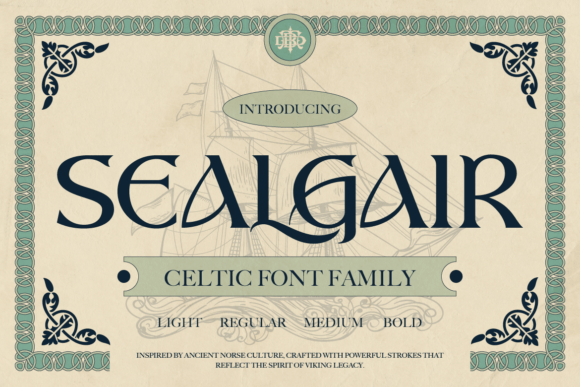
In the vast landscape of digital typography, finding a typeface that balances historical authenticity with contemporary legibility is a persistent challenge for designers. Many fonts inspired by ancient cultures sacrifice readability for ornamentation, resulting in text that looks authentic but fails to communicate effectively. Sealgair emerges as a solution to this specific design friction. It is a powerful and elegant Celtic font family that draws direct inspiration from ancient Norse and Gaelic aesthetics while adhering to modern typographic standards. Rather than merely mimicking old manuscripts, Sealgair captures the spirit of mythology, warriors, and timeless legends through distinctive curves, sharp edges, and an ornamental flow that remains clean and accessible.
For creators, business owners, and designers, understanding the utility of Sealgair goes beyond its visual appeal. It requires examining how its structural features translate into practical applications, from branding and editorial layouts to immersive game interfaces. This exploration delves into the functional characteristics of the typeface, its optimal use cases, and the considerations necessary for integrating it successfully into professional projects.
The Intersection of Myth and Readability
The primary value proposition of Sealgair lies in its hybrid nature. Traditional Celtic or Norse display fonts often rely heavily on intricate knotwork and dense blackletter forms, which can become illegible at smaller sizes or in longer passages. Sealgair approaches this differently by blending traditional stylistic markers with a clean skeletal structure. The result is a typeface that carries a bold historical character without overwhelming the viewer.
This balance is achieved through specific design choices. The letterforms feature sharp edges that evoke weaponry and runic carving, softened by curves that suggest organic flow and manuscript illumination. These elements are not applied as superficial textures but are built into the geometry of the glyphs. For a general consumer or a professional designer, this means the font communicates "ancient" and "mythical" instantly, yet the eye can still track across the page comfortably. This makes it viable not just for headlines, but for subheads, pull quotes, and short-form body copy where atmosphere is as important as information.
Versatility Through Weight and Alternates
A common limitation in niche display fonts is a lack of variation. A single weight forces designers to use the same intensity regardless of context. Sealgair addresses this by offering four distinct weights: Light, Regular, Medium, and Bold. This range allows for genuine typographic hierarchy within a single project.
- Sealgair Light: Best suited for elegant, ethereal designs where the Celtic influence should be subtle. It works well in luxury packaging or minimalist posters where negative space is paramount.
- Sealgair Regular: The standard workhorse for most applications, providing a balanced presence for titles and introductory text.
- Sealgair Medium: Offers increased visibility for UI elements or merchandise where the background texture might compete with the type.
- Sealgair Bold: Delivers maximum impact for logos, movie titles, and headers that demand immediate attention and convey strength.
Beyond weight, the inclusion of stylistic alternates and ligatures transforms Sealgair from a static font into a dynamic design tool. Ligatures—where two or more letters are joined into a single glyph—are particularly relevant in Celtic typography, as they mimic the connected nature of hand-drawn inscriptions. Utilizing these alternates prevents repetitive letter shapes in all-caps settings and adds a layer of bespoke craftsmanship to logo design and tattoo art. For users unfamiliar with OpenType features, accessing these alternates is typically done through standard design software panels, allowing for real-time customization without needing external editing tools.
Practical Applications Across Industries
Understanding where Sealgair performs best helps prevent misuse. While versatile, it is a thematic typeface, meaning it carries cultural baggage that must align with the project’s intent. Its strengths are most evident in specific sectors where narrative and atmosphere drive user engagement.
Entertainment and Interactive Media
In the realm of fantasy gaming and cinema, typography acts as a silent narrator. Sealgair is engineered for movie titles and game UIs because it bridges the gap between diegetic text (text that exists within the story world) and non-diegetic interface elements. A game menu set in Sealgair feels like part of the lore rather than a digital overlay. The font’s sharp edges remain crisp on high-resolution screens, while the ornamental flow maintains immersion during loading screens and chapter transitions.
Editorial and Publishing
Book covers and editorial layouts benefit from Sealgair’s ability to signal genre immediately. For fantasy novels, historical fiction, or collections of folklore, the typeface serves as a visual shorthand for the content within. However, editors should note that while Sealgair is readable, it is still a display face. Pairing it with a neutral serif or sans-serif for body text is essential. Sealgair should handle the hierarchy—chapter numbers, drop caps, and section breaks—while a more utilitarian font manages the long-form reading experience.
Branding and Merchandise
For businesses in the craft, heritage, or outdoor sectors, Sealgair offers a way to communicate authenticity without resorting to cliché. Breweries, artisanal food brands, and outdoor apparel companies can use the Bold or Medium weights to establish a rugged, established identity. In merchandise design, such as t-shirts or enamel pins, the font’s intricate details hold up well to printing processes. The multilingual support further extends its utility for international brands targeting markets with Celtic or Nordic heritage, ensuring that the aesthetic consistency is maintained across different languages.
Evaluating Suitability and Technical Considerations
Before licensing or downloading Sealgair, professionals should evaluate whether it aligns with their technical and aesthetic requirements. No typeface is universal, and recognizing limitations is as important as appreciating strengths.
Legibility Thresholds: Despite its clean construction, Sealgair contains fine details that may be lost at very small point sizes or in low-resolution web environments. It is primarily a display typeface. If your project requires 10pt body text for a legal disclaimer or dense technical manual, a standard grotesque or humanist sans-serif will serve you better. Reserve Sealgair for sizes above 14pt in print and equivalent pixel heights on screen.
Cultural Context: Because Sealgair is explicitly inspired by Norse and Gaelic aesthetics, it carries specific cultural connotations. Using it for a project unrelated to these themes—for example, a futuristic tech startup or a tropical travel agency—may create cognitive dissonance for the audience. The font signals history, earthiness, and legend. Ensure this semantic message supports, rather than contradicts, your brand voice.
File Formats and Compatibility: The font family is available in standard formats compatible with major operating systems and design software. Users should verify that their specific workflow supports OpenType features like ligatures and alternates. While most modern applications (Adobe Creative Cloud, Affinity, Figma) support these natively, some older or simplified web builders may require CSS implementation to access special characters fully.
Pairing Strategies for Balanced Composition
To maximize the effectiveness of Sealgair, thoughtful pairing is required. The goal is to let the Celtic character shine without creating visual chaos. Here are three proven approaches:
- The Neutral Anchor: Pair Sealgair with a geometric sans-serif like Montserrat or Futura. The mathematical precision of the sans-serif contrasts beautifully with the organic, hand-drawn feel of Sealgair, creating a modern-yet-ancient tension perfect for contemporary branding.
- The Classical Companion: Combine Sealgair with a traditional serif like Garamond or Caslon. This reinforces the historical narrative and creates a cohesive, bookish aesthetic ideal for editorial work and premium packaging.
- The Textural Contrast: Use Sealgair alongside a clean monospaced font. This juxtaposition highlights the ornamental nature of the Celtic letterforms and is particularly effective in game UI design, where data needs to look technical while retaining thematic flavor.
Final Thoughts on Typographic Authenticity
Sealgair represents a mature approach to cultural typography. It avoids the trap of caricature, offering instead a refined instrument for storytelling. Whether you are designing a tattoo that honors ancestral heritage, crafting the interface for an immersive RPG, or building a brand identity rooted in tradition, this typeface provides the necessary tools to execute your vision with both style and substance.
By leveraging its multiple weights, utilizing stylistic alternates, and respecting its display-oriented nature, designers can create compositions that feel genuinely connected to the past while functioning flawlessly in the present. In a digital environment saturated with generic typography, Sealgair offers a distinctive voice—one that speaks of warriors, legends, and enduring craftsmanship, translated clearly for the modern eye.