Grime Slime: Evaluating Fit for Urban and Horror Design Projects
Selecting the right display typeface for subculture branding requires balancing aesthetic impact with functional legibility. Grime Slime, created by Cikareotype, occupies a specific niche within the decorative font market by merging graffiti traditions with organic, fluid distortion. Unlike standard block lettering or clean sans-serifs, this typeface introduces a melting, viscous texture that evokes underground street art and macabre themes. For designers evaluating typography for streetwear, music media, or horror content, understanding the specific utility and limitations of Grime Slime is essential for making an informed resource allocation decision.
Defining the Aesthetic: Beyond Standard Graffiti Fonts
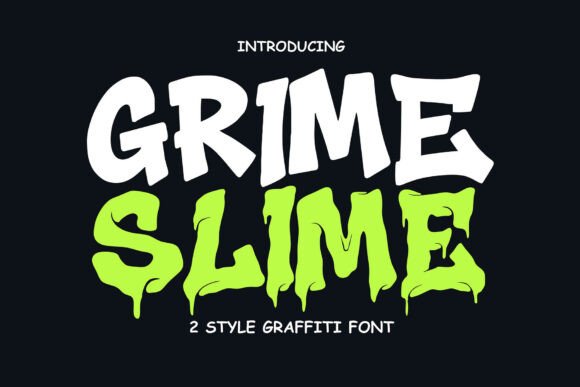
Grime Slime distinguishes itself through its interpretation of urban decay. While many fonts in the graffiti category focus on sharp angles, bubble structures, or wildstyle complexity, Grime Slime emphasizes liquidity. The character set features swaying edges and organic morphing that mimic slime trails rather than spray paint caps. This distinction matters when comparing options for projects requiring a "toxic" or biological edge versus a purely mechanical or architectural urban look.
The font retains a rebellious street sophistication without sacrificing the raw energy associated with underground culture. Each uppercase character, numeral, and punctuation mark displays intentional deformities. These are not random artifacts but calculated design choices that create a fierce visual rhythm. When evaluating this against cleaner novelty fonts, the tradeoff is clear: Grime Slime offers higher atmospheric density at the cost of neutrality. It is inherently opinionated, carrying a dystopian vibe that integrates seamlessly with post-apocalyptic artwork or funky modern branding but clashes with corporate or minimalist aesthetics.
Comparative Analysis: Grime Slime vs. Alternative Display Styles
When researching typography for high-impact visuals, designers often weigh multiple stylistic approaches. Understanding where Grime Slime sits relative to other categories helps clarify its best-fit scenarios.
Liquid Distortion vs. Traditional Wildstyle
Traditional wildstyle graffiti fonts prioritize interlocking letters and complex arrows, often rendering text illegible to those outside the culture. Grime Slime takes a different approach by prioritizing readability through fluid drips rather than structural abstraction. If the project goal is authentic, encrypted street credibility, a complex wildstyle font may be superior. However, for commercial applications like YouTube thumbnails, Twitch overlays, or merchandise where immediate message recognition is paramount, Grime Slime’s readable spectacle offers a practical advantage. It communicates the vibe of graffiti without demanding the viewer decode the letterforms.
Organic Grit vs. Digital Grunge
The grunge font category is saturated with options featuring distressed textures, ink blots, and eroded edges. Many of these rely on static noise or halftone patterns to simulate age. Grime Slime differs by simulating active movement. The oozing aesthetic suggests a living, melting substance rather than a weathered surface. For horror posters or game visuals involving biological themes, slime, or mutation, this dynamic quality outperforms static grunge. Conversely, if the design brief calls for vintage print degradation, industrial rust, or photocopy artifacts, a texture-based grunge font would likely be a more accurate fit than Grime Slime’s wet, fluid appearance.
Specialized Display vs. Versatile Sans-Serif
A common alternative consideration is using a bold, condensed sans-serif and applying manual distortion effects in vector software. While this allows for custom control, it increases production time and requires advanced illustration skills. Grime Slime provides a pre-baked solution that ensures consistent drip logic and spacing across the entire character set. The tradeoff involves flexibility; manual distortion allows for bespoke adjustments per layout, whereas Grime Slime locks the designer into its specific morphing style. For rapid turnaround on social media content or album covers, the dedicated typeface offers efficiency. For large-scale environmental signage requiring site-specific adaptation, manual manipulation may remain necessary.
Practical Application and Use Case Evaluation
Evaluating Grime Slime requires looking at specific deployment environments. Its strengths are context-dependent, and what works for one medium may fail in another.
- Streetwear and Apparel: The font’s bold weight and distinct silhouette make it highly effective for garment printing. The dripping aesthetic translates well to screen printing and DTG processes, as the organic shapes hide minor registration imperfections better than crisp geometric lines. It serves as a strong anchor for skate and BMX graphics where motion and grit are central themes.
- Digital Content Creation: For YouTube thumbnails and Twitch overlays, contrast is king. Grime Slime performs exceptionally well against dark backgrounds or neon color palettes. The slime effect remains undiminished at smaller digital resolutions, provided the text is not scaled down below its intended minimum size. Designers should test legibility at mobile viewport sizes before finalizing assets.
- Horror and Subculture Media: The macabre inspiration makes this a natural candidate for metal album covers, horror event flyers, and indie game UI. It bridges the gap between retro exploitation cinema aesthetics and modern urban horror. Compared to classic horror serif fonts, Grime Slime feels contemporary and rooted in current subcultural trends.
- Merchandise and Stickers: The self-contained nature of the letterforms allows for easy die-cutting. Unlike fonts with delicate serifs or thin connectors, Grime Slime’s thick, oozing structure maintains integrity when produced as vinyl decals or patches.
Technical Limitations and Decision Factors
No display font is universally applicable. Recognizing the constraints of Grime Slime prevents costly redesigns later in the production pipeline.
Character Set Restrictions: Currently featuring uppercase characters, numerals, and punctuation, Grime Slime lacks lowercase glyphs. This limits its utility for body copy or sentence-case headlines. Designers needing mixed-case hierarchy must pair this font with a complementary secondary typeface. Attempting to force all-caps usage for extended text blocks will result in visual fatigue and reduced comprehension.
Spacing and Kerning Challenges: The irregular, swaying edges inherent to the slime aesthetic can create uneven negative space. While the font includes kerning pairs, manual adjustment is often necessary when locking up tight headlines. Designers accustomed to the uniform spacing of geometric fonts should budget extra time for optical alignment. The fluid nature of the characters means that standard tracking values may cause drips to collide awkwardly or create unintended gaps.
Color and Contrast Dependencies: The dripping details define the font’s character. On low-contrast backgrounds or when used in thin stroke weights (if modified), these details can disappear. Grime Slime demands high contrast to function effectively. It is less suitable for watermarks, subtle background textures, or light-on-light embossing where fine detail is lost.
Tone Alignment: The font carries a potent, almost toxic energy. This is a feature, not a bug, but it dictates brand safety. Using Grime Slime for family-friendly events, luxury goods, or professional services creates cognitive dissonance. Even within urban branding, there is a spectrum; this font leans toward the gritty, underground, and chaotic end rather than the polished, aspirational end of street culture. Evaluators must ensure the target audience aligns with this specific frequency of rebellion.
Making the Final Selection
Grime Slime represents a specialized tool in the typographic arsenal. It excels when the objective is to convey untamed spirit, organic distortion, and underground authenticity simultaneously. Its value proposition lies in delivering a cohesive, hand-drawn slime aesthetic with the consistency of a digital font file.
For designers comparing options, the decision matrix should prioritize atmosphere over versatility. If the project requires a safe, neutral, or highly legible text face, Grime Slime is likely the wrong choice. However, for headlining, audacious statements, and thematic reinforcement in horror, gaming, and alternative fashion, it offers a distinct visual signature that generic grunge or standard graffiti fonts cannot replicate. By weighing its expressive strengths against its technical limitations and pairing it appropriately with supporting typography, designers can leverage Grime Slime to create compelling, genre-appropriate visual identities.