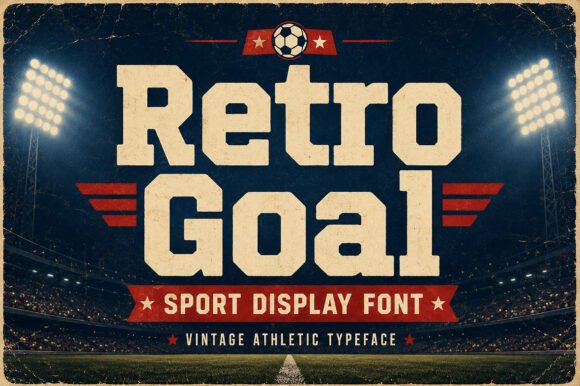
Retro Goal: Mastering Vintage Sports Typography Without the Clichés
Immerse yourself in the golden ages of sport with Retro Goal, an exemplar of vintage sport display fonts that captures a specific era of athletic aesthetics. Born out of a mix of classic varsity lettering, retro football memorabilia, and the spirit of college athletics, this typeface brings a robust and alluring aura to designs that demand authenticity. However, possessing a powerful font is only half the battle. Many designers and business owners acquire Retro Goal expecting it to automatically solve their branding challenges, only to find their projects looking dated rather than timeless. The distinction lies not in the asset itself, but in how you apply its block characters and inherent strength.
Retro Goal boasts block characters that echo the discipline inherent in sports, lending each design an unmatched athletic appeal. Yet, this very strength can become a liability if misapplied. To truly leverage this typeface for team logos, game posters, or apparel branding, you must understand where it excels and where it fails. Avoiding common typographic pitfalls ensures your investment translates into professional, high-impact visual communication rather than amateurish nostalgia.
The Readability Trap in Athletic Branding
The most frequent mistake when working with heavy display fonts like Retro Goal is prioritizing style over legibility. Because the font is designed to echo the boldness of vintage scoreboard typography and jersey numbering, users often assume it remains readable at any size or weight. This is a dangerous assumption. When scaled down for social media avatars, merchandise tags, or secondary text on a flyer, the thick strokes and tight counters can bleed together, creating illegible blobs of ink or pixels.
This error directly affects usability and brand recognition. A logo that looks commanding on a billboard may become unrecognizable on a mobile screen or an embroidered patch. To avoid this, always test Retro Goal at the smallest intended application size before finalizing your design. If the letterforms lose definition, do not force the issue. Instead, pair Retro Goal with a clean, geometric sans-serif for supporting text. Let the vintage font handle the headline or team name, while a modern counterpart manages contact details, dates, and disclaimers. This contrast preserves the magnetic persona of the main typeface while ensuring functional communication.
Misunderstanding Historical Context and Tone
Retro Goal is deeply rooted in the aesthetic of mid-century American athletics. A common oversight is applying this specific vintage flavor to contexts where it creates cognitive dissonance. For example, using this font for a futuristic esports tournament or a minimalist wellness brand can confuse the audience. The font carries a "whiff of nostalgia" that signals tradition, physical grit, and academic athletics. Ignoring these semantic associations leads to mixed messaging that weakens your brand identity.
Before committing to Retro Goal, evaluate whether your project aligns with its DNA. It is ideally suited for:
- Varsity and College Logos: Where tradition and institutional history are paramount.
- Football and Baseball Posters: Evoking the tactile feel of printed programs and stadium signage.
- Retro Badges and Emblems: Creating authentic-looking patches for jackets or caps.
- School Merchandise: Connecting alumni and students through shared visual heritage.
If your goal is sleek modernism or digital futurism, Retro Goal will likely work against you. However, if you are curating apparel branding or print-on-demand products that celebrate athletic heritage, this font is a distinguished partner. Recognizing this boundary prevents wasted effort and ensures your typography amplifies rather than contradicts your message.
Technical Pitfalls in Apparel and Print Production
Designing on-screen is vastly different from producing physical goods. Many creators select Retro Goal for t-shirt designs or team jerseys without considering production limitations. The font’s robust block characters are visually striking, but they present specific challenges in embroidery, screen printing, and vinyl cutting. Intricate serifs or extremely tight kerning that looks fine in vector software can cause thread breaks, ink bleed, or peeling edges in manufacturing.
Neglecting these technical realities increases cost and reduces quality. A complex logo might require simplification for embroidery, or you may need to adjust the tracking to prevent vinyl letters from lifting after washing. Always consult with your printer or manufacturer early in the process. Ask for a stitch-out sample or a print proof specifically for Retro Goal. You may need to slightly modify the letter spacing or stroke width to accommodate the medium. This proactive step saves money on reprints and ensures the final product matches your digital vision. Remember, a font that looks perfect on a monitor must also survive the rigors of laundry and wear.
Licensing and Commercial Usage Oversights
A critical but often overlooked detail involves licensing terms. Enthusiasm for a font’s aesthetic sometimes leads users to download Retro Goal from unauthorized sources or assume a personal license covers commercial merchandise. This exposes entrepreneurs and small business owners to legal risks and potential cease-and-desist orders. Furthermore, free or pirated versions often lack complete character sets, missing essential glyphs, numbers, or punctuation needed for comprehensive branding.
To protect your business and ensure design integrity, always acquire Retro Goal through reputable foundries or marketplaces. Verify that your license explicitly covers your intended use case, especially for print-on-demand products, packaging labels, and client work. A proper commercial license is not just a legal safeguard; it guarantees access to the full font family, including alternate characters and ligatures that add uniqueness to your work. Investing in legitimate typography demonstrates professionalism and respect for the type designer’s craft, which ultimately reflects positively on your own brand reputation.
Balancing Nostalgia with Modern Design Standards
While Retro Goal excels at evoking the past, relying solely on vintage tropes can make a design feel like a costume rather than a brand. Some designers over-accessorize the font with excessive textures, grunge overlays, and sepia filters, resulting in a cluttered composition that obscures the typeface’s inherent quality. The font already possesses a strong personality; adding too many competing vintage elements dilutes its impact and makes the design feel chaotic.
A better approach is restraint. Allow Retro Goal to be the primary nostalgic anchor while keeping other design elements relatively clean. Use negative space effectively to let the block characters breathe. If you are designing sports event flyers or social media graphics, consider using flat colors or subtle gradients instead of heavy distressing. This balances the historical weight of the font with contemporary design sensibilities, making the content feel relevant to today’s audience while honoring the past. The goal is to evoke the spirit of college athletics, not to replicate a damaged artifact.
Ultimately, Retro Goal is a versatile tool for those who understand its nuances. By avoiding readability errors, respecting historical context, accounting for production realities, securing proper licensing, and exercising stylistic restraint, you transform this typeface from a mere decorative element into a strategic asset. Whether you are composing compelling team logos or elevating merchandise packaging, thoughtful application ensures your designs carry the true strength and discipline of the golden age of sport.