Spektora: Mastering Retro Typography with Bold, Condensed Character
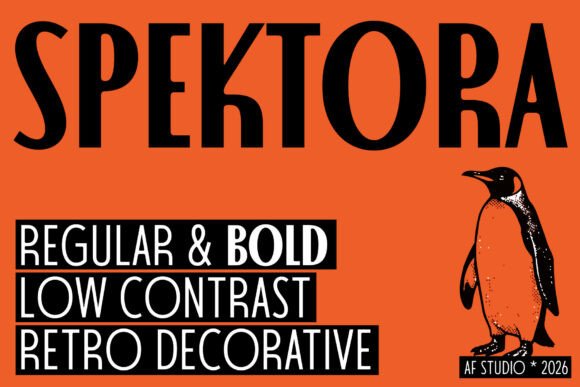
In the vast landscape of digital typography, finding a typeface that balances historical nostalgia with modern utility is a persistent challenge for designers and business owners alike. We often find ourselves choosing between fonts that feel authentically vintage but lack readability, or contemporary options that are legible but devoid of soul. Spektora emerges as a compelling solution to this dichotomy. It is a condensed display font that carries a distinct retro feel and a bold personality, specifically engineered for projects that demand immediate visual engagement without appearing forced or gimmicky.
Understanding Spektora requires looking beyond its aesthetic surface to appreciate its structural intelligence. Tall, narrow, and full of character, this typeface was made for designs that need to catch attention without trying too hard. For creators navigating the crowded spaces of social media, retail packaging, or event branding, Spektora offers a unique combination of low contrast and decorative details that evoke a vintage mood, while its clean structure keeps the overall feeling fresh and accessible. This article explores how to leverage this versatile tool effectively, ensuring your design choices serve both form and function.
The Anatomy of Attention: Why Condensed Matters
To understand why Spektora performs so well in headline applications, one must first understand the psychology and mechanics of condensed typography. In an era where screen real estate is precious and physical shelf space is competitive, horizontal space is a luxury. Standard width typefaces often require significant scaling down to fit lengthy messages into narrow containers, which can compromise legibility and impact.
Spektora addresses this spatial constraint through its verticality. By maintaining a tall x-height and narrowing the character width, it allows designers to set larger point sizes within confined boundaries. This is not merely a space-saving tactic; it is a hierarchy strategy. The vertical stress of the letterforms draws the eye downward, creating a sense of stability and authority. When you add it big and stack it tight, the typeface transforms from simple text into a graphical element. The density of the ink on the page creates a texture that feels substantial, making it ideal for labels, posters, and menus where the message must be absorbed instantly.
Balancing Vintage Mood with Modern Clarity
Many retro-inspired fonts fall into the trap of excessive ornamentation, sacrificing usability for style. Spektora distinguishes itself through restraint. The low contrast—meaning the difference between thick and thin strokes is minimal—contributes significantly to its versatility. High-contrast vintage fonts can look elegant at large sizes but often disappear or become spindly when scaled down or viewed on lower-resolution screens. Spektora’s consistent stroke weight ensures that the decorative details remain visible and crisp across various media.
This clean structure is what keeps the font feeling fresh rather than like a costume piece. It borrows the attitude of mid-century signage and 1970s editorial headers but strips away the grime and irregularities associated with aged print. For business owners and professionals, this means you can tap into the emotional resonance of nostalgia without making your brand look outdated or unprofessional. It bridges the gap between heritage and contemporary design standards, allowing for a timeless yet current aesthetic.
Practical Applications Across Industries
Versatility is the hallmark of a successful display font. While Spektora has a strong personality, it is malleable enough to serve diverse sectors. Its utility extends far beyond simple decoration; it functions as a communication tool tailored for specific environments.
- Hospitality and Menus: Restaurants and cafes often struggle with menu legibility. Spektora works naturally for section headers and dish names, providing clear differentiation from body text. Its condensed nature allows for descriptive titles even in multi-column layouts, guiding the customer’s eye efficiently through offerings.
- Retail Packaging and Labels: On a store shelf, products have milliseconds to make an impression. The bold personality of Spektora cuts through visual clutter. Whether used on craft beer cans, artisanal food jars, or cosmetic boxes, the font conveys quality and craftsmanship. The ability to stack type tightly maximizes label area without reducing font size to illegibility.
- Event Branding and Posters: Concerts, festivals, and exhibitions rely on typography to set the tone before a single image is processed. Spektora’s retro feel aligns perfectly with music and arts culture, yet its cleanliness ensures logistical information (dates, venues) remains readable. It likes to be seen, making it perfect for hero images and promotional banners.
- Digital Headlines and Social Media: In the scroll-heavy environment of Instagram or TikTok, static text needs weight. Spektora’s bold option provides the necessary anchor for video thumbnails and carousel covers. The vertical orientation also complements the portrait aspect ratio of mobile devices better than wide, sprawling typefaces.
Navigating Weights: Regular vs. Bold
A common pitfall in using display fonts is relying on a single weight, which can lead to monotonous layouts. Spektora comes in Regular and Bold, and understanding the interplay between these two is key to unlocking its potential. Mixing sizes and creating contrast feels simple and consistent because the underlying skeleton of both weights is identical.
The Regular weight possesses enough presence to stand alone for subheads or secondary information. It retains the decorative charm without overwhelming the viewer. This makes it suitable for longer phrases or supporting text that still needs to harmonize with the primary headline. Conversely, the Bold weight is an assertive tool. It increases the black-to-white ratio dramatically, turning words into shapes. Use the Bold weight for single keywords, short impactful statements, or numerical data that requires emphasis.
When combining them, consider scale over style changes. A massive Regular weight paired with a small Bold caption can create a sophisticated, editorial look. Alternatively, a tight stack of Bold headlines with Regular metadata establishes a clear, utilitarian hierarchy. Because the family is cohesive, you avoid the visual friction that occurs when pairing unrelated typefaces.
Evaluating Suitability: Strengths and Considerations
While Spektora is a powerful asset, no typeface is a universal panacea. Professionals and creators must evaluate its suitability based on project goals. Recognizing both strengths and limitations ensures the font enhances rather than hinders the user experience.
- Best for Display, Not Body: As a condensed display font, Spektora is optimized for short bursts of text. It is not designed for extended reading passages. Using it for paragraphs will cause eye fatigue due to the narrow tracking and vertical rhythm. Pair it with a highly legible sans-serif or serif for body copy to maintain balance.
- Contextual Tone: While the retro feel is versatile, it does carry a specific cultural weight. It may not be appropriate for industries requiring sterile precision, such as medical technology or financial law, unless used ironically or very sparingly. Evaluate whether the "attitude" of the font aligns with your brand voice.
- Spacing Sensitivity: Condensed fonts can sometimes appear cramped if default tracking is left untouched. Spektora benefits from manual kerning adjustments, especially in all-caps settings. Adding slight positive tracking can improve airiness and luxury, while negative tracking can enhance urgency and density. Test spacing at actual output size, as screen rendering differs from print.
- Color and Background Interaction: Due to its low contrast and decorative details, Spektora requires sufficient contrast against its background. Avoid placing it over busy photographic textures without a backing plate or overlay. Solid colors or subtle gradients allow the intricate forms of the letters to breathe and perform their best.
Making the Final Selection
Choosing a typeface is ultimately an exercise in problem-solving. You are selecting a voice for your visual message. Spektora offers a distinct advantage for those seeking to inject warmth, history, and confidence into their work. It solves the practical issue of fitting impactful text into limited spaces while satisfying the emotional desire for character-driven design.
For general consumers and business owners reviewing design proposals, recognizing the value of a font like Spektora helps in articulating feedback. If a design feels flat or generic, suggesting a switch to a typeface with more structural personality can elevate the entire project. For creators, integrating Spektora into your toolkit provides a reliable go-to for moments when standard geometric sans-serifs feel too cold and ornate scripts feel too fussy.
Ultimately, Spektora succeeds because it respects the fundamentals of good design. It understands that being retro doesn't mean being obsolete, and being bold doesn't mean being loud. It is a thoughtful synthesis of past and present, offering a robust solution for anyone who believes that typography should do more than just convey information—it should make people stop, look, and feel something. Whether you are designing a festival poster, rebranding a local bakery, or crafting a social media campaign, Spektora provides the structural integrity and stylistic flair necessary to ensure your message is not just read, but remembered.