Sorry Mister: A Versatile Typeface for Education, Branding, and Craft
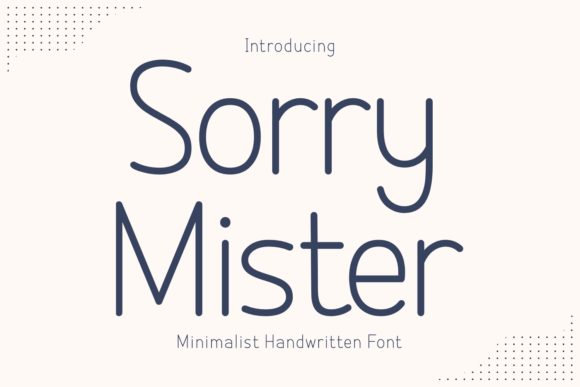
In the vast landscape of digital typography, finding a typeface that balances professional cleanliness with genuine warmth is often a challenge. Designers and creators frequently have to choose between sterile modernism and overly decorative scripts that sacrifice readability. Introducing Sorry Mister, a supremely versatile and charming typeface that exudes minimalism and simplicity in all its glory. This font bridges the gap between structured design and human connection, offering a unique solution for projects that require both legibility and personality.
Embodying a delightful blend of playful and clean aesthetics, Sorry Mister effortlessly evokes joy, creativity, and modernity. Unlike traditional handwritten fonts that can appear messy or difficult to parse at smaller sizes, this typeface maintains a disciplined structure while retaining the organic feel of natural penmanship. Whether you are an educator designing lesson plans, a small business owner crafting a brand identity, or a DIY enthusiast creating personalized gifts, understanding the practical applications of this font can elevate your visual communication.
The Anatomy of Playful Minimalism
To utilize Sorry Mister effectively, it helps to understand what makes it distinct from other handwriting-style fonts. The design philosophy centers on "approachable geometry." The letterforms are rounded and open, which psychologically signals friendliness and safety to the reader. However, the spacing and baseline alignment remain consistent, ensuring that the text does not look amateurish.
This duality is the font’s primary strength. It possesses a handwritten touch that serves as a perfect font choice for teachers because it captures the lively energy of a buzzing classroom without descending into chaos. For professional designers, this means the typeface can be used in headers, pull quotes, and call-to-action buttons where engagement is paramount, yet clarity cannot be compromised. The minimalism ensures it pairs exceptionally well with stricter sans-serif body copy, creating a visual hierarchy that guides the eye naturally through the content.
Educational Applications and Child-Centric Design
One of the most significant use cases for Sorry Mister lies within educational environments and children's media. Visual processing in young learners is heavily influenced by typography; dense or sharp serifs can sometimes create cognitive friction. The Sorry Mister font doubles as an adorable kids’ font, capturing vivid imagination and innocence while remaining highly legible for developing readers.
- Classroom Materials: Worksheets, flashcards, and behavior charts benefit from the font’s friendly tone, making learning feel less intimidating and more inviting.
- Children’s Book Design: Self-published authors and illustrators find that this typeface complements hand-drawn artwork without competing for attention. It reads clearly even when overlaid on textured backgrounds.
- Special Education Resources: The open counters and distinct character shapes can be helpful for neurodivergent learners who may struggle with standard textbook typography.
- School Communication: Newsletters and permission slips formatted with this font feel personal and community-focused rather than bureaucratic.
When designing for this demographic, the goal is to maintain engagement without causing distraction. Sorry Mister achieves this by being expressive enough to hold interest but simple enough to facilitate rapid reading comprehension.
Branding with Informal Authority
Beyond the learning arena, Sorry Mister transitions smoothly as a tasteful branding font helping to carve distinct identities for brands looking for a friendly and informal appeal. In an era where consumers crave authenticity over corporate polish, businesses are increasingly adopting softer typographic voices. This is particularly relevant for industries such as boutique retail, artisanal food production, wellness coaching, and family-oriented services.
The versatility extends to businesses looking for a modern, clean font that speaks to organization. For example, a daycare center might use it to signal safety and fun, while a sustainable skincare brand might use it to convey natural ingredients and transparency. The key to successful commercial application is restraint. Because the font carries so much personality, it works best as a display face for logos, packaging labels, and social media graphics, rather than for long-form legal disclaimers or dense product descriptions. By pairing it with a neutral typeface for body text, brands can harness the charm of Sorry Mister while maintaining professional credibility.
Crafting, Sublimation, and Personal Projects
For the maker community, typography is often the difference between a generic item and a cherished keepsake. Sorry Mister seamlessly fits into crafting and DIY projects, making handmade creations stand out with a touch of personalization. Its vector-based construction means it scales infinitely without losing edge quality, which is critical for physical production methods.
Optimizing for Cricut and Sublimation
It is the perfect Cricut or sublimation font, infusing a playful spirit into your crafting endeavors. However, users should be aware of specific technical considerations when moving from screen to physical substrate:
- Vinyl Cutting: While the font is clean, always check the smallest point size your cutter can handle. The rounded terminals of Sorry Mister generally weed easily, but extremely thin connectors in lowercase letters may require transfer tape with higher tack.
- Sublimation Printing: The solid fill of the characters makes this font ideal for dye-sublimation. Unlike distressed or grunge fonts that can look muddy after heat pressing, Sorry Mister retains crisp edges on polyester fabrics and coated ceramics.
- Laser Engraving: The consistent stroke width ensures uniform burn depth. This prevents the uneven engraving that often occurs with variable-width script fonts.
Just imagine how charming your T-shirts, stickers, decals, and labels will look when adorned with this font. It brings a lasting sparkle to your summer parties or intimate birthday celebrations, encapsulating those unforgettable moments with a dash of fun. From custom cake toppers to personalized wedding favors, the typeface adds a layer of bespoke care that mass-produced items simply cannot replicate.
Evaluating Suitability for Your Project
While Sorry Mister is remarkably adaptable, it is not a universal solution. To ensure it aligns with your specific needs, consider the following evaluation criteria before integrating it into your workflow.
Strengths and Ideal Scenarios
The typeface excels in contexts requiring emotional resonance. If your project aims to make the viewer smile, feel welcomed, or recall a sense of nostalgia, this font is a strong candidate. It performs exceptionally well in short bursts of text—headlines, captions, names, and slogans. Its gender-neutral playfulness also makes it safer for broad audiences compared to hyper-feminine scripts or aggressive block letters.
Considerations and Limitations
Designers must recognize where this typeface falls short. Due to its inherent informality, Sorry Mister is generally inappropriate for luxury fashion, financial institutions, legal documentation, or medical signage where authority and precision are non-negotiable. Additionally, because it mimics handwriting, setting it in all-caps can reduce legibility and negate the natural flow of the letterforms. Always test the font in the intended medium; what looks charming on a high-resolution monitor may lose its nuance when embroidered at two inches wide or printed on uncoated newsprint.
Practical Tips for Implementation
To maximize the impact of Sorry Mister, follow these best practices derived from real-world usage:
- Mind the Hierarchy: Use weight variations if available, or rely on size contrast to establish importance. Since the font is visually light, it often needs to be set larger than equivalent serif fonts to achieve the same optical weight.
- Color Selection: Soft pastels, warm earth tones, and vibrant primaries complement the font’s character. Avoid stark black on white for large displays; a dark charcoal or navy blue often feels more harmonious with the typeface’s gentle aesthetic.
- Whitespace is Key: Do not crowd this font. Its charm relies on breathing room. Generous margins and padding allow the playful forms to exist without feeling cluttered.
- Test Across Devices: If using for web design, ensure the webfont loads correctly and that fallback fonts do not drastically alter the layout. The specific metrics of Sorry Mister mean that generic cursive fallbacks can cause significant reflow issues.
Final Thoughts on Typographic Versatility
Typography is more than just arranging letters; it is the voice of your visual message. Sorry Mister offers a rare combination of utility and emotion, serving as a reliable tool for professionals and hobbyists alike. By understanding its strengths in education, branding, and craftsmanship, users can leverage this typeface to create work that resonates on a human level.
Whether you are labeling pantry jars, designing a preschool curriculum, or refreshing a boutique logo, the value lies in the font's ability to simplify complexity without losing heart. It reminds us that even in a digital-first world, there is enduring power in the aesthetic of the human hand. When selected with intention and applied with care, Sorry Mister transforms ordinary text into an experience of joy, clarity, and connection.