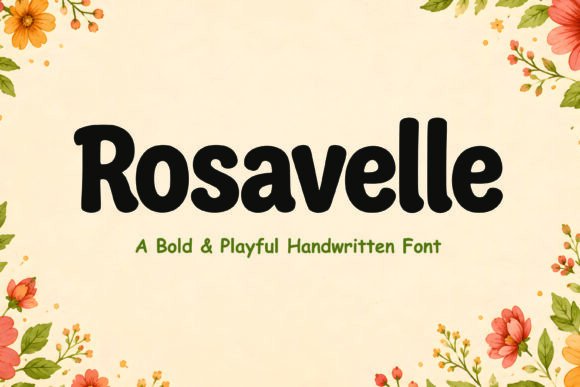
Rosavelle: Bringing Warmth and Personality to Modern Visual Identity
In an era dominated by sleek minimalism and rigid geometric sans-serifs, the creative landscape is experiencing a significant shift toward authenticity and emotional connection. Designers and brand strategists are increasingly seeking typography that feels human rather than manufactured. This is where Rosavelle enters the conversation as a vital tool for contemporary visual communication. As a bold and friendly rounded display font, it is specifically engineered to inject warmth, charm, and distinct personality into creative projects that might otherwise feel sterile or impersonal.
The relevance of this typeface extends far beyond mere aesthetics. It addresses a growing fatigue with corporate uniformity. When audiences scroll through social media feeds or walk down retail aisles, they are bombarded with identical visual languages. Rosavelle offers a necessary disruption. Its soft curves and thick strokes create an immediate sense of approachability, signaling to the viewer that the brand behind the text values connection over cold efficiency. For professionals aged 20 to 50 navigating the saturated markets of e-commerce, content creation, and small business, selecting a typeface like Rosavelle is a strategic decision to prioritize user experience and emotional resonance.
The Evolution of Friendly Typography in Digital Spaces
To understand why a font like Rosavelle is gaining traction, one must look at the broader evolution of digital design. For much of the 2010s, the tech industry and subsequent design trends favored sharp, hyper-legible, and neutral typefaces. While functional, these fonts often lacked soul. As digital interactions replaced physical ones, particularly following global shifts in remote work and online commerce, users began craving digital experiences that mimicked the tactile comfort of the real world.
This "softening" of digital interfaces is not just a trend; it is a response to changing user expectations. Modern consumers associate rounded forms with safety, inclusivity, and friendliness. Rosavelle capitalizes on this psychological preference without sacrificing professional credibility. Unlike novelty fonts that compromise readability for style, Rosavelle maintains strong legibility even at smaller display sizes. This balance is crucial for modern workflows where assets must perform equally well on a 4K monitor, a smartphone screen, and printed packaging.
Furthermore, the rise of the creator economy has democratized design. Entrepreneurs, bloggers, and educators are now their own art directors. They require tools that deliver high-end results without requiring a degree in typography. A hand-lettered feel that looks intentional rather than accidental allows non-designers to achieve a bespoke aesthetic. Rosavelle bridges the gap between amateur enthusiasm and professional polish, making it a staple for those building personal brands or niche businesses.
Practical Applications Across Diverse Industries
Versatility is the hallmark of any enduring typeface. While some display fonts are relegated to specific niches, Rosavelle’s construction allows it to traverse multiple industries effectively. Its bold weight commands attention, while its rounded terminals soften the delivery, making it suitable for contexts ranging from playful to sophisticated.
Packaging and Retail Branding
In the physical retail space, packaging serves as the silent salesman. For artisanal food brands, organic skincare lines, and boutique cafes, the typography on the label communicates quality before the product is ever opened. Rosavelle’s cozy, handcrafted aesthetic aligns perfectly with the "maker" movement. It suggests that a human being was involved in the creation process, which justifies premium pricing and builds trust. When used on coffee bags, candle labels, or bakery boxes, the font evokes sensory warmth that rigid serifs simply cannot replicate.
Social Media and Content Creation
Digital content creators face the challenge of stopping the scroll within milliseconds. Bold typography is essential for headlines and quote cards, but aggressive boldness can sometimes read as shouting. Rosavelle provides volume without aggression. Its playful hand-lettered feel makes Instagram carousels, Pinterest pins, and YouTube thumbnails feel inviting. For influencers and marketers, this translates to higher engagement rates because the visual tone matches the conversational nature of modern social platforms.
Children’s Design and Education
Educators and designers in the children’s market understand that typography influences learning environments. Harsh angles can feel intimidating to young readers, whereas rounded forms encourage exploration. Rosavelle is exceptionally well-suited for educational materials, storybooks, and classroom decor. Its clarity ensures that letters are easily distinguishable for early readers, while its personality keeps the material engaging. This practical utility makes it a favorite among teachers creating custom worksheets and ed-tech companies designing child-friendly interfaces.
Print-on-Demand and Merchandise
The print-on-demand (POD) sector relies heavily on typography-driven designs. T-shirts, mugs, stickers, and tote bags often feature text as the primary graphic element. In this space, generic fonts lead to commoditized products. Rosavelle offers POD sellers a way to differentiate their catalogs. The font’s unique character turns simple phrases into desirable graphics. Because it retains its integrity when scaled up for apparel or down for stickers, it reduces the need for extensive manual vector adjustments, streamlining the production workflow for freelancers and shop owners.
Navigating Current Market Preferences and User Needs
The current market favors brands that exhibit transparency and vulnerability. The polished perfection of previous decades has given way to a preference for the "perfectly imperfect." Rosavelle embodies this zeitgeist. Its slight irregularities and hand-drawn nuances signal authenticity. For business owners, this is a powerful non-verbal cue. It tells customers that the brand is accessible and open to dialogue.
Moreover, accessibility is no longer optional; it is a baseline requirement. While decorative fonts often fail WCAG (Web Content Accessibility Guidelines) due to poor contrast or confusing letterforms, Rosavelle’s thick strokes provide ample surface area for color contrast. This makes it a responsible choice for inclusive design. Marketers and web designers can utilize it for headings and calls to action without alienating users with visual impairments, provided it is paired with appropriate background colors.
We are also seeing a convergence of digital and physical branding. A café might use Rosavelle on their physical signage, their menu, their Instagram bio, and their loyalty app. Consistency across these touchpoints builds brand equity. Because Rosavelle performs well in both print and pixel environments, it simplifies the creation of comprehensive brand guidelines. Designers do not need to select secondary display fonts for different mediums; this single typeface can anchor the entire visual identity system.
Strategic Recommendations for Implementation
To maximize the impact of Rosavelle, creators should adhere to a few best practices grounded in modern design principles. Understanding how to wield this tool is just as important as acquiring it.
- Pair with Neutral Body Text: Rosavelle is a display font with significant personality. To prevent visual clutter, pair it with a clean, structured sans-serif or a highly legible serif for body copy. Let Rosavelle be the voice, while the supporting text acts as the foundation.
- Mind the Hierarchy: Use the bold weight for primary headlines and key takeaways. Avoid using it for long paragraphs or dense blocks of text. Its strength lies in short, punchy statements and logos.
- Leverage Negative Space: Rounded fonts benefit from generous spacing. Do not tighten the tracking excessively. Allowing the letters to breathe enhances the friendly, open feeling and improves readability at a glance.
- Contextual Color Choices: While the font works in black and white, it truly shines when paired with warm, earthy palettes or soft pastels. These color combinations reinforce the organic, handcrafted vibe. Conversely, pairing it with neon or high-contrast dark modes can create a striking, retro-modern juxtaposition.
- Test Across Mediums: Before finalizing a brand identity, test Rosavelle in its intended environments. Print a mockup of the packaging, view the logo on a mobile device, and see how it reads in embroidery or vinyl cutting. Ensuring technical performance prevents costly rebrands later.
The Future of Expressive Display Type
As we move forward, the distinction between "professional" and "playful" will continue to blur. The future of business communication is human-centric, and typography is leading this charge. Tools like Rosavelle are not merely stylistic choices; they are adaptations to a marketplace that values emotional intelligence. For the entrepreneur launching a sustainable fashion line, the teacher designing inclusive curriculum, or the marketer crafting a community-focused campaign, this font represents a bridge to their audience.
Ultimately, the enduring appeal of Rosavelle lies in its ability to make the digital feel tangible and the commercial feel personal. It respects the intelligence of the viewer while appealing to their emotions. In a crowded visual ecosystem, standing out does not always mean being louder; sometimes, it means being warmer. By integrating such thoughtful typography into their workflows, creators and professionals can build brands that are not only seen but genuinely felt. This alignment of form, function, and feeling is what defines successful design in the current decade, ensuring that projects resonate deeply with their intended audiences.