Ready for School: Interactive Display Typography
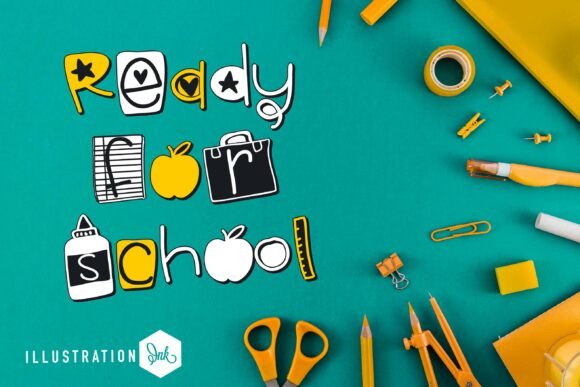
Visual communication in educational spaces requires a delicate balance between structured information and playful engagement. Standard typography often fails to capture the tactile energy of a classroom environment, while purely illustrative elements can lack the functional utility required for signage and packaging. Ready for School addresses this specific design challenge by functioning as both a typeface and an illustration system. This novelty display font integrates dingbat-infused character frames shaped like notebook paper, apples, rulers, glue bottles, and bookbags directly into the keystroke workflow. Rather than treating text and imagery as separate layers, this tool allows designers to construct messages where the letterforms themselves serve as architectural containers for learning themes.
For professionals creating materials for children aged four through ten, the distinction between "decorative" and "functional" is often blurred. Ready for School bridges this gap by offering geometric variety within hand-drawn outlines that maintain legibility at display sizes. The value lies not just in the aesthetic charm, but in the efficiency of producing cohesive visual systems without sourcing, licensing, and aligning disparate graphic assets. When every character carries thematic weight, the entire layout reinforces the educational narrative automatically.
Streamlining Classroom Decor and Environmental Design
Teachers and school administrators frequently face the task of creating welcoming, organized environments with limited budgets and time. Custom signage usually requires either expensive professional printing or labor-intensive DIY crafting. Ready for School simplifies this process by enabling the creation of professional-grade environmental graphics using standard office software. Because the font treats classroom supplies as structural elements, a simple welcome sign typed in this typeface immediately communicates organization and warmth without requiring additional clipart or borders.
Consider the practical application of labeling storage bins or creating daily schedule cards. Using a standard sans-serif font requires adding icons separately to help pre-readers associate words with objects. With Ready for School, the container shape provides that iconographic context inherently. A schedule entry typed inside a ruler frame suggests math or measurement time, while text housed in a glue bottle silhouette implies art or craft activities. This reduces cognitive load for young students who are still developing literacy skills, as the typography itself acts as a visual cue. For educators managing their own classroom branding, this eliminates the need to learn complex vector software or purchase extensive sticker libraries.
Elevating Boutique Stationery and Product Packaging
The market for educational stationery and children’s products is saturated with generic aesthetics. Independent creators and small business owners must differentiate their offerings through distinct visual identities that signal quality and thoughtfulness. Ready for School serves as a foundational element for boutique collections where consistency across multiple SKUs is essential. When designing notebook covers, pencil cases, or flashcard sets, using a unified typographic system ensures that the product line feels curated rather than assembled from random stock elements.
Packaging design specifically benefits from the architectural nature of these character frames. On crowded retail shelves or digital marketplaces like Etsy, readability at thumbnail size is paramount. The bold, hand-drawn outlines of Ready for School maintain their integrity when scaled down, unlike intricate illustrations that may become muddy. Furthermore, because the shapes are typographic, they align perfectly with baseline grids. This solves a common pain point in packaging layout where illustrative elements disrupt text flow. Designers can set headlines and product names simultaneously, ensuring that the "back-to-school" excitement translates into clear, purchasable information. The result is packaging that looks professionally typeset while retaining the approachable, human touch necessary for connecting with parents and caregivers.
Enhancing Digital Engagement Through Typographic Play
Social media managers and content creators in the education sector face the constant pressure of producing high-impact visuals rapidly. Algorithms favor content that stops the scroll, yet educational content must remain accessible and on-brand. Ready for School offers a unique solution for Instagram carousels, Pinterest pins, and YouTube thumbnails by turning text into interactive visual hooks. Unlike static images, text set in this typeface remains editable, allowing creators to update messaging for different seasons or promotions without redesigning the entire graphic template.
The interactive potential extends beyond static social posts. For developers and designers building educational games or apps, this typeface can serve as a UI asset library. Buttons shaped like bookbags or apples provide intuitive affordances for young users who navigate interfaces through recognition rather than reading. Because the font is vector-based (assuming OTF/TTF format), it scales infinitely for various screen densities without pixelation. This versatility supports rapid prototyping; a designer can mock up an entire game interface simply by typing, drastically reducing the iteration cycle before committing to custom asset production. However, creators should note that while the font provides structure, color and animation must be applied externally to achieve full interactivity.
Strategic Considerations for Legibility and Hierarchy
While Ready for School is a powerful tool for display purposes, understanding its limitations is crucial for successful implementation. As a novelty display typeface, it is engineered for headlines, short phrases, and labels rather than body copy. Attempting to use it for paragraphs of instructional text will compromise readability and dilute its visual impact. Professional designers should pair this typeface with a clean, neutral sans-serif or rounded serif for supporting content. This contrast establishes a clear visual hierarchy, guiding the viewer’s eye from the playful primary message to the detailed secondary information.
Accessibility also warrants careful consideration. The irregular shapes and hand-drawn qualities, while charming, can pose challenges for readers with dyslexia or visual processing differences. When using Ready for School in public-facing educational materials, always ensure sufficient color contrast between the text and the background fill of the character frames. Additionally, avoid relying solely on the shape to convey critical safety or procedural information. The font should enhance comprehension, not replace universal design standards. Testing layouts with actual users in the target age demographic can reveal whether specific character frames are being recognized as intended or if they require supplementary iconography.
Optimizing Workflow Efficiency for Freelancers and Agencies
For freelance designers and agencies specializing in family-oriented brands, billable hours are a finite resource. Projects involving children’s themes often suffer from scope creep due to the iterative nature of illustration. Clients may request adjustments to icon styles, colors, or compositions repeatedly. Ready for School mitigates this friction by standardizing the visual vocabulary early in the project. Once the typeface is selected, the stylistic parameters are set. Revisions become a matter of retyping text or adjusting tracking and leading, rather than redrawing vectors.
This efficiency extends to file management and deliverables. Instead of handing off dozens of linked image files alongside a document, the designer delivers a single font file or outlined text. This reduces the risk of broken links and simplifies future edits for clients who may want to make minor changes in-house. For print-on-demand businesses, this typographic approach ensures consistent output across different vendors and substrates. The geometric precision of the character frames means that registration issues common with multi-color spot illustrations are minimized, particularly when the font is used in a single color or duotone treatment.
Bridging Nostalgia and Contemporary Brand Standards
The "back-to-school" aesthetic often leans heavily on nostalgia, but modern educational brands must also project competence, inclusivity, and current pedagogical values. Ready for School navigates this tension by utilizing familiar motifs rendered with contemporary geometric sensibilities. The hand-drawn quality evokes the personal touch of a teacher’s chalkboard, while the consistent spacing and modular construction meet current branding standards for scalability and digital adaptability.
This duality makes the typeface particularly valuable for rebranding projects. Organizations looking to refresh their identity without alienating existing stakeholders can use Ready for School as a transitional element. It honors traditional associations with learning while signaling a move toward more designed, intentional communication. Marketers should leverage this emotional resonance in campaign storytelling, positioning the typography not just as decoration, but as a reflection of the brand’s commitment to making learning feel personal and accessible. By treating the typeface as a strategic asset rather than a mere stylistic choice, professionals can create work that resonates deeply with both the adults purchasing the products and the children experiencing them.