Bupre: Evaluating a Mythic Display Serif for Heritage and Fantasy Branding
Selecting the right typeface for niche projects often requires balancing historical authenticity with modern legibility. For designers and creators working within the realms of folklore, fantasy, and artisanal heritage, standard serif fonts frequently lack the specific cultural texture required to convey depth. Bupre emerges as a specialized solution to this challenge, offering a spellbinding display serif that captures a mythic-and-monumental soul. Unlike generic medieval revival fonts that often sacrifice readability for aesthetic gimmickry, Bupre integrates bold, high-contrast letterforms with rhythmic, hand-drawn Celtic knot terminals. This unique combination bridges the gap between historical insular script and contemporary branding needs, making it a practical asset for specific commercial and creative applications.
Defining the Visual Architecture of Bupre
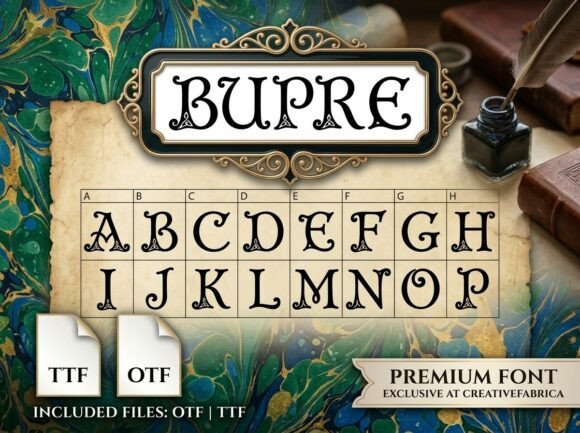
To understand the utility of Bupre, one must first analyze its structural composition. It is fundamentally a high-contrast display serif, meaning it possesses significant variation between thick vertical strokes and thin horizontal connectors. This weight distribution provides the "legendary personality" necessary for commanding attention on book covers or product packaging. However, the defining characteristic lies in its terminals and flourishes. Rather than using simple serifs or standard swashes, the font incorporates intricate triquetra-inspired details and Celtic knotwork directly into the glyph structure.
These elements are not merely overlaid decorations; they appear integrated into the stroke logic, suggesting a connection to Insular art traditions found in manuscripts like the Book of Kells. The result is a typeface that feels ancient without appearing archaic or illegible. The hand-drawn quality of the knots introduces organic imperfection, preventing the digital stiffness that often plagues historically inspired fonts. For professionals evaluating typography, this level of detail indicates a design process focused on cultural resonance rather than superficial styling. The heavy structural weight ensures that even at smaller display sizes, the intricate details remain distinct rather than muddying into visual noise.
Practical Applications in Niche Markets
Bupre is not a universal workhorse; it is a specialist tool. Its value proposition is highest in sectors where storytelling and atmosphere are as important as the information itself. Based on current design trends and market demands, four primary use cases demonstrate its effectiveness.
Artisanal Beverage Labeling
The craft mead and spirits industry relies heavily on shelf appeal that communicates tradition and craftsmanship. Bupre serves as an excellent primary header for independent artisanal mead labels. The font’s monumental weight stands out against textured paper stocks and dark glass bottles, while the Celtic flourishes signal heritage and natural ingredients. In this context, the typeface acts as a visual shorthand for quality and history, helping products differentiate themselves in a saturated market. Designers should note that the high contrast works particularly well with metallic foils and embossing techniques common in premium beverage packaging.
Tabletop RPG Sourcebooks and Materials
For publishers and self-creators in the tabletop gaming space, immersion is paramount. Bupre functions effectively for chapter titles, class headers, and map legends in RPG sourcebooks. It avoids the overused tropes of standard blackletter or generic fantasy serifs, offering players and game masters a fresh yet familiar aesthetic. The triquetra-inspired flourishes align naturally with magic systems, druidic lore, and ancient histories common in fantasy settings. Crucially, because the base letterforms are grounded in readable serif proportions, it maintains clarity during gameplay reference, avoiding the frustration associated with purely decorative fantasy fonts.
Heritage-Themed Apparel and Merchandise
Clothing brands focusing on folklore, neo-paganism, or historical reenactment require typography that translates well to fabric. Bupre’s bold structure ensures legibility on t-shirts, hoodies, and embroidered patches. The rhythmic terminals add a tactile quality that complements natural fibers like linen, wool, and cotton. When used in apparel design, the font supports a brand identity that feels established and culturally rooted rather than costumey. Its versatility allows it to pair effectively with both minimalist modern layouts and ornate traditional illustrations.
Folkloric Social Media Headers
Digital creators, bloggers, and educators focusing on mythology, history, or folk horror need impactful visuals for social media profiles and post headers. Bupre delivers high-impact readability at screen resolutions. The intricate details provide visual interest that encourages engagement, while the strong silhouette remains recognizable even in thumbnail sizes. For content creators building a personal brand around niche historical topics, consistent use of Bupre establishes immediate thematic recognition across platforms.
Evaluating Usability and Technical Performance
Aesthetic appeal must be matched by functional reliability. In professional evaluation, Bupre demonstrates several strengths regarding usability, though it also presents specific constraints that designers must manage.
- Legibility at Display Sizes: Despite its ornamental nature, the core skeleton of the letters adheres to classical proportion. This ensures that words remain decipherable even when the flourishes are prominent. It performs best at 24pt and above; below this threshold, the intricate knotwork may lose definition depending on the output medium.
- Pairing Versatility: Bupre carries significant visual weight and complexity. It demands pairing with clean, neutral sans-serifs or simple humanist serifs for body text. Attempting to pair it with other decorative fonts usually results in visual clutter. Its strong personality means it should generally be restricted to headlines, logos, and short pull quotes.
- Cultural Authenticity: For projects requiring strict historical accuracy, users should verify that the specific style of Celtic knotwork aligns with their target era or region. While Bupre captures a general "insular script" vibe, it is a modern interpretation designed for fantasy and branding, not a scholarly reconstruction.
- Technical Rendering: The complex curves and overlapping strokes require proper anti-aliasing. Designers working for web should test rendering across browsers to ensure the fine details do not artifact. In print, adequate bleed and resolution are necessary to preserve the crispness of the terminals.
Strengths and Limitations for Professional Use
Understanding where Bupre excels and where it falls short is essential for efficient workflow integration. Its primary strength is its ability to evoke a specific emotional response—mysticism, age, and solidity—without resorting to cliché. It solves the problem of needing a "fantasy font" that still looks professional and trustworthy. The hand-drawn characteristics prevent it from feeling sterile, adding a layer of artisanal value to digital designs.
However, its limitations are equally important. Bupre is strictly a display face. It is unsuitable for long-form reading, user interfaces, or data-heavy documents. The rhythmic terminals, while beautiful, can create awkward spacing issues in all-caps settings or tight kerning scenarios. Designers may need to manually adjust tracking or utilize OpenType features if available to optimize specific word combinations. Additionally, its strong cultural coding makes it inappropriate for corporate, tech, or medical branding, where such specific historical associations could confuse the message.
Assessing Long-Term Value and Audience Fit
For the target audience of professionals, entrepreneurs, and serious hobbyists aged 20–50, typeface selection is an investment in brand equity. Bupre offers long-term value for those operating within its specific niche. Trends in fantasy and heritage aesthetics cycle regularly, but the appreciation for well-crafted, culturally resonant typography remains constant. Because Bupre is built on solid typographic principles rather than fleeting visual memes, it is less likely to date quickly compared to trend-chasing novelty fonts.
This font is most valuable for creators who have moved beyond generic assets and require bespoke visual identities. If you are designing a mass-market thriller novel or a SaaS landing page, Bupre is irrelevant. If you are launching a line of botanically inspired gin, publishing a campaign setting based on Iron Age mythology, or rebranding a museum exhibit on Celtic art, Bupre provides a foundational visual element that communicates competence and atmosphere simultaneously.
Ultimately, Bupre succeeds because it respects the intelligence of its audience. It assumes the viewer understands the references to insular art and mythic storytelling, using those references to build trust rather than just decoration. For designers and business owners in these fields, it represents a reliable, high-quality tool that enhances narrative depth. When evaluated against the criteria of distinctiveness, readability, and thematic alignment, Bupre proves itself to be more than a novelty; it is a functional component of effective heritage and fantasy communication. By integrating this typeface thoughtfully, creators can ensure their visual presentation matches the richness of their content, bridging the ancient and the modern with professional precision.