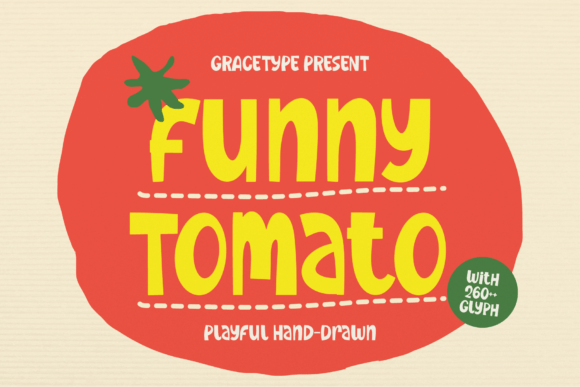
Funny Tomato: Strategic Typography for Authentic Brand Positioning
Selecting the right typeface is rarely just an aesthetic decision; it is a fundamental business strategy that communicates brand values before a single word of copy is read. Funny Tomato represents a specific strategic choice for brands aiming to bridge the gap between organic authenticity and modern indie appeal. This display font captures a juicy-and-carefree soul through thick, casual hand-drawn letterforms that defy rigid grid systems. For entrepreneurs, marketers, and creators targeting audiences who value genuine human connection over corporate polish, understanding the functional application of this typeface is essential for effective visual communication.
The typeface is uniquely characterized by asymmetrical shapes, uneven widths, and a bouncy baseline rhythm. These are not merely decorative quirks; they are semiotic signals. In a digital landscape saturated with sterile geometric sans-serifs and high-contrast luxury serifs, Funny Tomato offers a heavy footprint that feels grounded and approachable. It serves as a visual shorthand for "handmade," "fresh," and "unpretentious." However, leveraging this font effectively requires moving beyond novelty. Successful implementation demands a thoughtful approach to hierarchy, readability, and audience alignment to ensure the whimsy supports rather than undermines your operational goals.
Aligning Visual Tone with Business Objectives
Before integrating Funny Tomato into a design system, stakeholders must evaluate whether its inherent personality aligns with their long-term positioning. This font excels in environments where trust is built through transparency and warmth rather than authority and precision. It is strategically useful for independent organic snack packaging, where the typography must mirror the tactile nature of the product. When a consumer picks up a bag of artisanal chips or a jar of small-batch jam, the uneven stroke weight of Funny Tomato reinforces the narrative of small-scale production and natural ingredients.
Similarly, in children’s storybook layouts and educational materials, the font’s bouncy rhythm aids in engagement without feeling condescending. Educators and publishers can utilize this typeface to create learning environments that feel safe and exploratory. The irregularity of the letterforms mimics early childhood handwriting, creating a subconscious bridge between the reader and the content. For casual restaurant menus, the font suggests a farm-to-table ethos, signaling to diners that the experience will be relaxed and the ingredients fresh. In each of these contexts, Funny Tomato is not just decoration; it is a tool for managing customer expectations and reinforcing brand promises.
Strategic Applications in Digital and Print Media
While versatile, Funny Tomato performs best when applied with intention across specific touchpoints. Its high-impact nature makes it ideal for headlines and short-form messaging, but it requires careful handling in digital spaces.
- Social Media Headlines: Use the font for thumb-stopping text overlays on Instagram or TikTok. The heavy footprint ensures legibility on small screens, while the playful tone encourages interaction and shares.
- Packaging Front-of-Pack: Reserve Funny Tomato for the product name or key flavor descriptors. Pair it with a clean, neutral sans-serif for nutritional information and regulatory text to maintain compliance and readability.
- Event Signage and Wayfinding: For farmers' markets, festivals, or pop-up shops, the font creates immediate thematic consistency. Its organic charm helps temporary structures feel established and welcoming.
- Email Marketing Headers: Break the monotony of standard newsletter templates by using Funny Tomato for subject lines or hero image text. This signals a shift in tone from transactional to relational.
Mitigating Risks Through Contextual Awareness
The very traits that make Funny Tomato effective also present potential risks if misapplied. The asymmetrical shapes and uneven widths can quickly degrade legibility if used in body copy or at small sizes. A common strategic error is treating this display font as a universal solution. Doing so dilutes its impact and frustrates users attempting to parse dense information. Decision-makers must establish clear usage guidelines to prevent visual fatigue and accessibility issues.
Furthermore, there is a risk of tonal dissonance. Using Funny Tomato in contexts requiring gravitas—such as financial reporting, legal disclaimers, or luxury positioning—can erode trust. The font signals informality; if your message requires seriousness, this typeface will actively work against your communication goals. Even within playful brands, balance is critical. Overusing the font can make a brand appear juvenile rather than authentically quirky. The goal is to use Funny Tomato as an accent that highlights key messages, not as a blanket texture that obscures meaning.
Planning for Accessibility and Hierarchy
Inclusive design should be central to any typography strategy. Because Funny Tomato features a bouncy baseline and irregular forms, it does not meet WCAG standards for body text. Planners and designers must pair it with highly legible companion fonts. A structured grotesque or a humanist sans-serif often provides the necessary contrast to ground the layout. This pairing creates a dynamic tension: the structure facilitates navigation and comprehension, while Funny Tomato injects personality and emotional resonance.
When planning social media assets or packaging, always test the font at actual size. What looks charming on a 27-inch monitor may become illegible on a mobile feed or a shelf tag. Establish minimum point sizes and maximum line lengths specifically for this typeface. Consider color contrast carefully; the thick strokes of Funny Tomato can bleed into dark backgrounds or disappear against busy photography. Ensuring accessibility is not just a compliance issue—it expands your potential audience and demonstrates professional competence.
Operationalizing Creativity for Consistent Results
For freelancers, agencies, and in-house teams, adopting Funny Tomato requires updating brand guidelines and asset libraries. Ad-hoc usage leads to inconsistent branding, which weakens market recognition. Create a dedicated style guide section for this typeface that specifies approved pairings, color treatments, and prohibited uses. Provide team members with pre-approved templates for social media, presentations, and signage. This reduces friction in the creative process and ensures that every output maintains strategic coherence.
Productivity also benefits from standardized typographic rules. When designers do not have to reinvent the wheel for every campaign, they can focus on higher-value creative problem-solving. By defining exactly how and where Funny Tomato fits into the ecosystem, you transform a subjective aesthetic preference into an objective operational asset. This clarity is particularly valuable for distributed teams or when onboarding new collaborators, ensuring that the brand’s "juicy-and-carefree soul" remains intact regardless of who executes the design.
Evaluating Long-Term Brand Equity
Trends in typography cycle rapidly, but authentic brand voices endure. While Funny Tomato currently resonates with the indie-organic zeitgeist, its true value lies in its ability to humanize a brand. As businesses scale, maintaining that human connection becomes increasingly difficult. Strategic use of this typeface can serve as a tether to the brand’s origins, reminding customers of the personal touch that defines the company.
However, decision-makers should periodically audit the effectiveness of their typographic choices. Monitor engagement metrics on social posts featuring Funny Tomato versus those using alternative headers. Gather qualitative feedback on packaging perception. Does the font still signal freshness and joy, or has it become stale? Typography strategy is iterative. Being willing to adjust the volume or application of Funny Tomato based on real-world data ensures that your visual identity evolves alongside your business objectives.
Ultimately, Funny Tomato is more than a collection of glyphs; it is a strategic instrument for differentiation. In markets crowded with homogeneous design, its deliberate imperfection stands out. But standing out is only the first step. Converting attention into loyalty requires that the font’s whimsy be backed by substantive value and executed with professional rigor. By approaching this typeface with the same level of strategic planning applied to pricing, distribution, or product development, creators and business owners can harvest a fresh burst of joy that drives tangible results. The success of such a distinctive visual element depends entirely on the intentionality behind its use. When aligned with clear goals and grounded in user needs, Funny Tomato transforms from a stylistic flourish into a cornerstone of memorable, effective brand communication.